Sources, not vibes
Consensus
Searches scientific papers for what the evidence says about a question, and tries to show agreement rather than a single link. Good for 'does this claim hold up?' and a poor place to learn narrative craft. Read it as a map of a literature, then go to the studies that matter.
Best for
Nonfiction writers checking whether a popular claim survives contact with research papers.
Pricing
Freemium. Free searches. Paid plans raise limits and add deeper synthesis across papers.
Listing checked 14 October 2026. Plans move. The vendor's page wins an argument with this one.
In-depth review
Consensus review
Last checked 14 October 2026 against the vendor's public pages. Prices and features change; check the vendor before you buy.
Writer's Toolbelt review
Consensus
An AI search engine for peer-reviewed research. For nonfiction writers who need evidence, not vibes.
- research papers searched (vendor figure)
- Pro per month, billed annually
- partner university libraries (vendor figure)
What it is
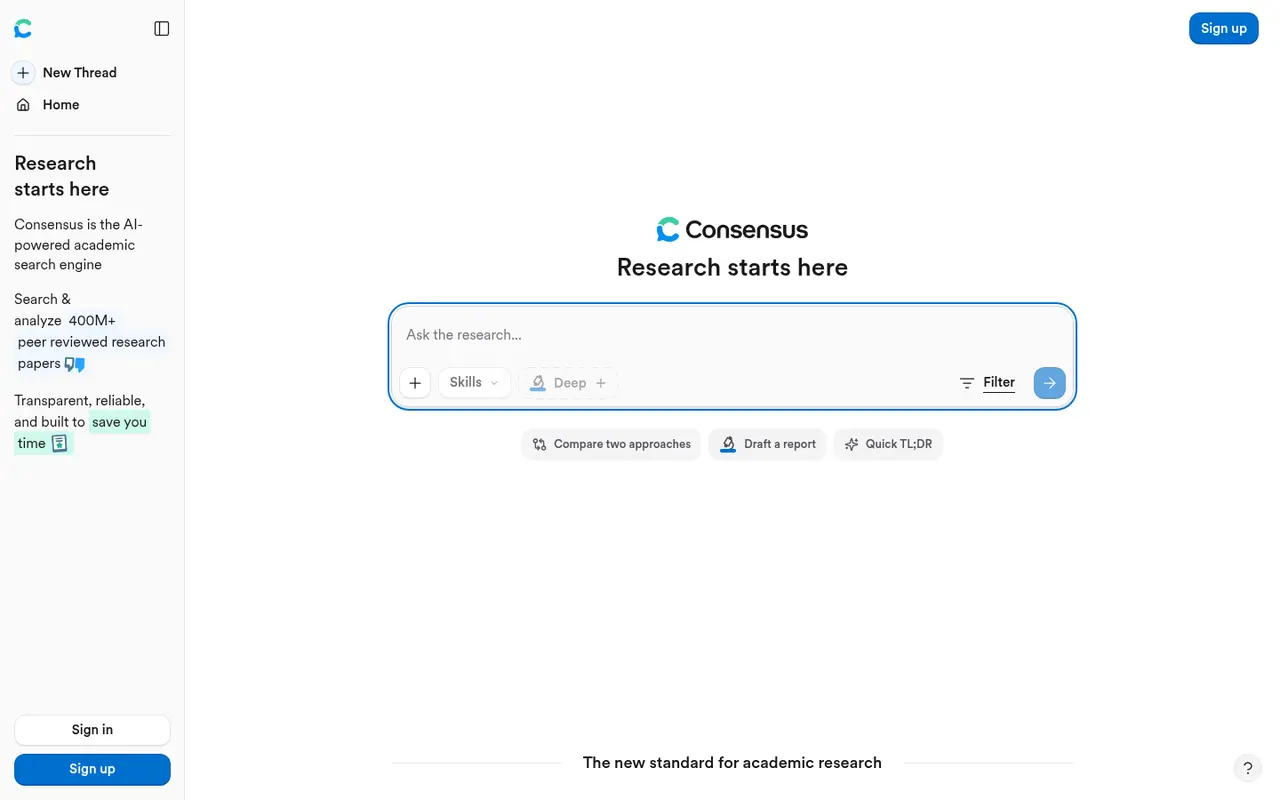
Consensus is an AI-powered academic search engine. It searches and analyses peer-reviewed literature. Its home page mentions both "250M+ research papers, including licensed full text content from leading publishers" and, in its tagline, "400M+ peer-reviewed research papers", so treat the exact count as a vendor figure. It gives cited answers, and its Deep Search "builds a comprehensive search strategy, expanding key terms, identifying conflicting arguments, and exploring the citation graph."
Who it's for
- Nonfiction authors in health, science, psychology, education and business, where claims need studies behind them.
- Journalists and bloggers fact-checking a claim quickly.
- Novelists researching a technical or medical detail, occasionally.
It is not a drafting tool, and it won't help with fiction craft.
Key features in practice
- Paper search over a large corpus of peer-reviewed research, free.
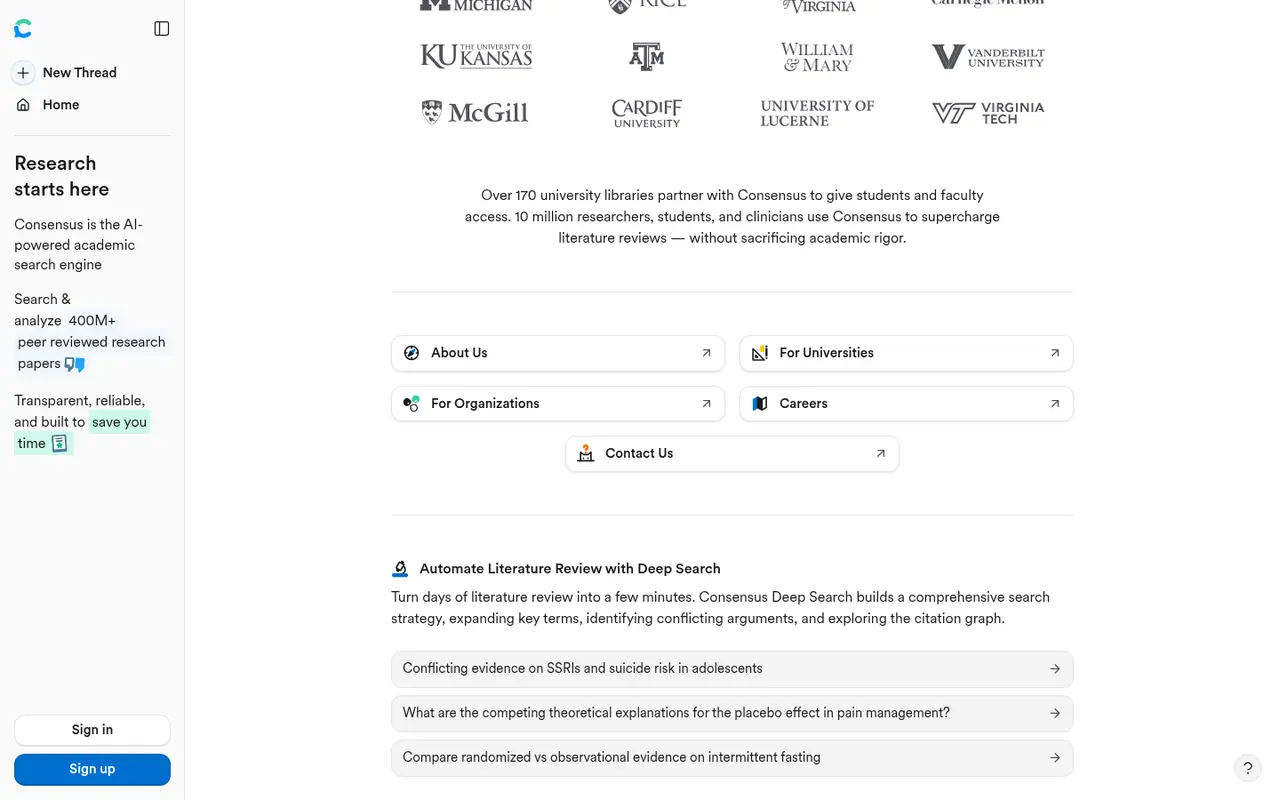
- Pro messages. AI analysis with citations. Free includes 10 a month, and Pro is unlimited.
- Deep reviews. More thorough literature reviews across many studies: 3 a month on Free, 15 on Pro, 200 on Deep.
- Research tools such as analysis and the citation graph, unlocked on Pro.
- API and MCP access. Pro includes 500 uses a month and Deep 2,000, with paid overage, so you can call Consensus from other AI tools.
- Discounts. The pricing page invites students, faculty and clinicians to claim one.
Pricing (checked 14 October 2026)
| Plan | Price | Includes |
|---|---|---|
| Free | $0 | Basic paper search, 10 Pro messages, up to 3 Deep reviews a month |
| Pro | $12/month billed annually ($144/year) | Unlimited Pro messages, 15 Deep reviews a month, all research tools, 500 API/MCP uses |
| Deep | $45/month billed annually ($540/year) | Unlimited Pro messages, 200 Deep reviews a month, 2,000 API/MCP uses |
Team and Enterprise plans are listed separately. Monthly-billing prices weren't captured, so check the vendor site.
Pricing at a glance
- FreePaper search, 10 Pro messages, 3 Deep reviews/moFree
- ProUnlimited Pro messages, 15 Deep reviews/mo$12/mo
- Deep200 Deep reviews/mo$45/mo
Using it as a writer
- Ask a yes/no or "what does the evidence say" question. Consensus works best on specific questions, such as "Does journaling reduce anxiety?", rather than open topics.
- Open the papers. Use the summaries to find studies, then read the abstract and methods before citing anything.
- Note study design and sample size. A single small study is not "research shows".
- Use Deep reviews for chapters, not for single sentences. Save them for the arguments your book stands on.
- Keep a source log with the study, year, DOI and what you're using it for. Your editor and fact-checker will thank you.
Strengths
- Grounded in peer-reviewed literature, not the open web.
- Citations by default.
- Inexpensive Pro plan, plus a usable free tier.
- API and MCP access for writers who already use AI assistants.
Writer's Toolbelt editorial scores
Consensus scorecard
7.2/10
- Source quality9/10
- Speed to an answer8/10
- Ease of use8/10
- Fit for fiction writers3/10
- Value for money8/10
Weaknesses
- Academic scope. It's weak for history, culture or anything not in journals.
- Summaries can oversimplify nuanced or conflicting evidence. Always read the papers.
- Little value for fiction.
How it compares
- Consensus vs Elicit. Elicit leans toward systematic reviews and data extraction at a higher price. Consensus is faster for quick evidence questions.
- Consensus vs scite. scite shows how papers cite each other (supporting or contrasting), which is ideal for checking whether a claim holds up.
- Consensus vs Perplexity. Perplexity searches the open web broadly. Consensus is narrower but more rigorous.
Feature comparison
AI research tools compared
| Feature | Consensus | Elicit | Scite | Perplexity | NotebookLM |
|---|---|---|---|---|---|
| Free plan | Yes | Yes | No | Yes | Yes |
| Lowest listed paid price | Yes$12 | Yes$49 | Yes$12 | Yes$17 | Yes$4.99 |
| All paid tiers have published prices | Yes | Yes | PartlySome tiers: contact sales or check vendor site | PartlySome tiers: contact sales or check vendor site | PartlySome tiers: contact sales or check vendor site |
| Competes with ProseEngine (we disclose) | No | No | No | No | No |
Verdict
For nonfiction writers who make evidence-based claims, Consensus is one of the best-value research tools in this directory. Start free, and upgrade to Pro once you're doing research every week.
FAQ
Is Consensus free? Yes. Free includes paper search, 10 Pro messages and up to 3 Deep reviews a month.
How much is Consensus Pro? $12 a month billed annually ($144 a year) as of 14 October 2026.
Can I cite Consensus? Cite the underlying papers, not the AI summary.
Nearby on the shelf
Drafting
ChatGPT
The general assistant most writers already have open. Useful for brainstorming, blurb variants, and line rewrites if you paste the scene and say what you want. It does not hold a novel together unless you build that memory yourself with projects or files, and it will invent sources if you let it.
Best for Writers who want one flexible assistant and will bring their own outline, pages, and skepticism.
FreemiumFiction and nonfictionDrafting
Claude
A general assistant that writers often prefer for long passages, tone, and a calmer revision pass. Projects can hold notes and chapters you upload. It is still a chat, not a novel app: continuity across a whole book is only as good as the pages you put in front of it.
Best for Drafting and revision when you want a careful reader more than a plot machine.
FreemiumFiction and nonfictionResearch
Elicit
Finds academic papers and pulls out methods, samples, and findings into a table. Built for literature reviews, not for blog posts or vibes. A novelist researching a profession can use it; a nonfiction writer on a contested topic should. The extracted cell can still misread a paper, so the PDF remains the source.
Best for Serious nonfiction, and research-heavy fiction that needs papers rather than the first Google result.
FreemiumNonfiction