Sound and jacket
Coverfairy
A browser studio for indie authors that keeps title type separate from the artwork, then exports ebook, print wrap, audiobook square, mockups, and a typeset interior from the same project. AI images are optional and metered. It will not lay out a photo book or a fixed-layout children's book, and full-resolution files stop when the pass ends.
Best for
Indie authors who want an editable cover and a prose interior in one project, without a design subscription.
Pricing
Freemium. Free account: 4 one-time AI image credits and watermarked drafts, no card. On 16 October 2026 a Week Pass was $6 for 7 days (20 AI credits, no renewal) and Monthly was $12 (40 AI credits per billing period). Non-AI exports are unlimited while a pass is active.
Listing checked 16 October 2026. Plans move. The vendor's page wins an argument with this one.
In-depth review
Coverfairy review
Last checked 16 October 2026 against the vendor's public pages. Prices and features change; check the vendor before you buy.
Writer's Toolbelt review
Coverfairy
Editable cover type, optional AI art, and a typeset interior in one browser project. Pay for a week or a month when you need the files.
- to start, 4 one-time AI images
- Week Pass, 7 days, no renewal
- Monthly, 40 AI credits
What it is
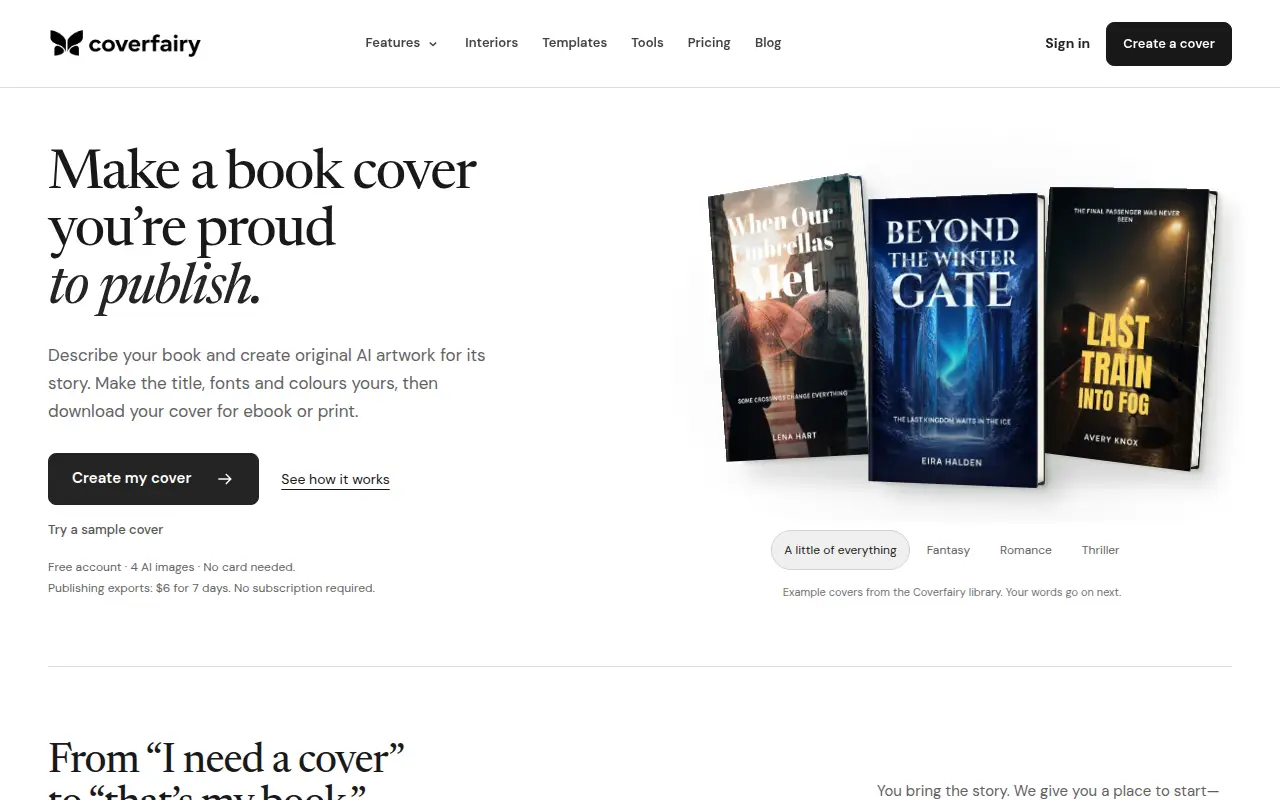
Coverfairy is a browser studio for independent authors who need a cover and a typeset interior in the same project. The home page's instruction is: describe the book, create original AI artwork, keep the title, fonts, and colours editable, then download an ebook cover or a print wrap. The fact sheet, maintained by Coverfairy Editorial, calls it a book-finishing studio: the cover, the formatted manuscript, the final page count, a calculated print spine, and the release files live in one project.
It is independent of Amazon KDP, Canva, and ACX. The about page says so, and says files are built from those platforms' published requirements. Coverfairy is one word. The fact sheet's own "verified" line is dated 10 August 2026; the prices below are what the live pages showed on 16 October 2026, and they matched that fact sheet.
Who it's for
- Indie authors publishing prose: novels, memoirs, nonfiction, and story collections. The interiors page says that is the typesetting job.
- Authors who already have art, or who want a first cover without baking the title into the picture.
- Authors who need a print wrap and an audiobook square from the same design, plus mockups for a launch post.
It is a weak fit for photo-heavy art books, complex textbooks, or fixed-layout children's books. The interiors page says so. Poetry with exacting line breaks "deserves a manual pass" before export. It is also a weak fit if you want a general design app for ads, newsletters, and social templates that are not the book. That is a different product.
Key features in practice
- Words stay off the artwork. Generated images are requested without lettering, so the title, subtitle, and author name stay editable type. Fonts, layouts, shadows, and text colour can change without a new image. The home page says a free account's four AI credits are for images; changing words and styles spends nothing.
- Three ways to get art. A curated or suggested starting image, an upload you own or license, or a generated direction. AI is optional. The art page says you can select one area, describe a fix, and keep earlier versions. Generated art stays identified in the project record. You are responsible for reviewing it before you publish. The fact sheet is explicit that technical checks do not guarantee originality, rights, genre fit, or retailer acceptance after you change the file.
- Print wraps. Paperback and case-laminate hardcover PDFs. For KDP, dimensions come from binding, trim, paper, and the formatted page count. For IngramSpark, Lulu, and Barnes & Noble Press paperbacks, you supply the spine width from that service's current title-specific template. The home page says some printers require that official template, and it links a guide. If a retailer rejects an unchanged export because Coverfairy calculated the dimensions wrong, the pricing page says to send the rejection and the project settings: they will correct the file or refund the affected pass.
- Audiobook and mockups. An ACX square at 2,400 × 2,400 pixels, recomposed from the art and the type rather than padded around a portrait cover. Mockups put the cover on a book, a nightstand, or an e-reader. A separate free mockup tool downloads promotional PNGs without a watermark and without an account. Project mockups inside the studio are part of the paid exports.
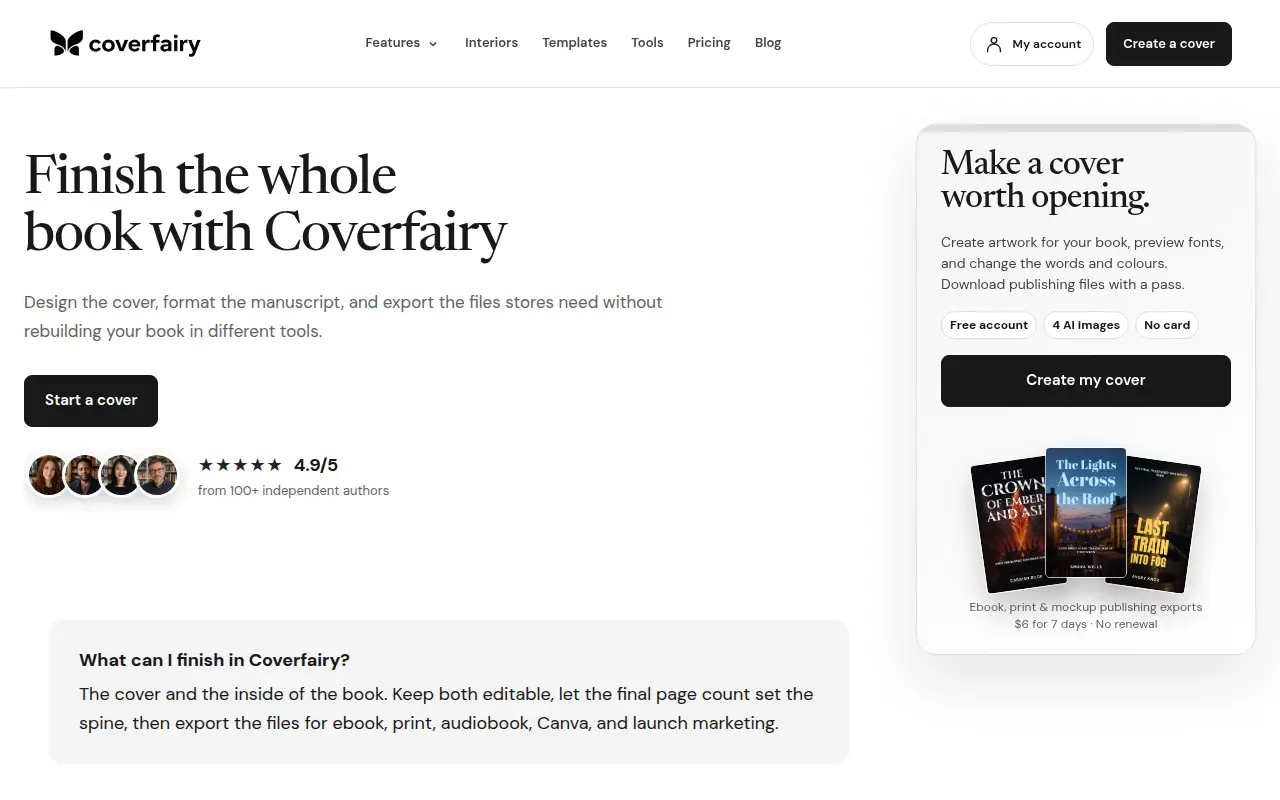
- Interior. Import Word or EPUB, or paste text. Coverfairy finds chapters, notes, and images, applies a theme, and sets line spacing, page breaks, widows, orphans, facing pages, and chapter openings. Exports are a validated EPUB 3, a print-ready interior PDF, and a large-print PDF. The page count in the preview is the page count used for the KDP spine, so a change in the interior can update the cover in the same project. You can also upload a cover you already have.
- Canva, as a file. Download a PPTX or a flattened PDF and import it into Canva. The fact sheet says direct "Open in Canva" is not live. Editable text or a fixed design are both offered.
- What a pass unlocks. Ebook cover (high-resolution JPG or PNG for KDP, Apple Books, and Kobo), full print cover at 300 DPI, audiobook square, mockups, Canva-ready files, EPUB, print PDF, and large-print PDF. Free cover drafts are watermarked. Projects remain after the pass ends. You can keep editing and previewing. A new full-resolution export needs an active pass.
Pricing (checked 16 October 2026)
| Plan | Price | AI credits | Exports |
|---|---|---|---|
| Free account | $0, no card | 4, one time | Watermarked cover drafts. Guests can preview without an account. |
| Week Pass | $6 once, for 7 days | 20 | Unlimited non-AI Cover, Interior, and mockup exports. No renewal. |
| Monthly | $12 per month | 40 per billing period | The same studio. Renews until you cancel. |
Pricing at a glance
- Free4 one-time AI images; watermarked cover draftsFree
- Week Pass
$6 once for 7 days
- Monthly40 AI credits per billing period$12/mo
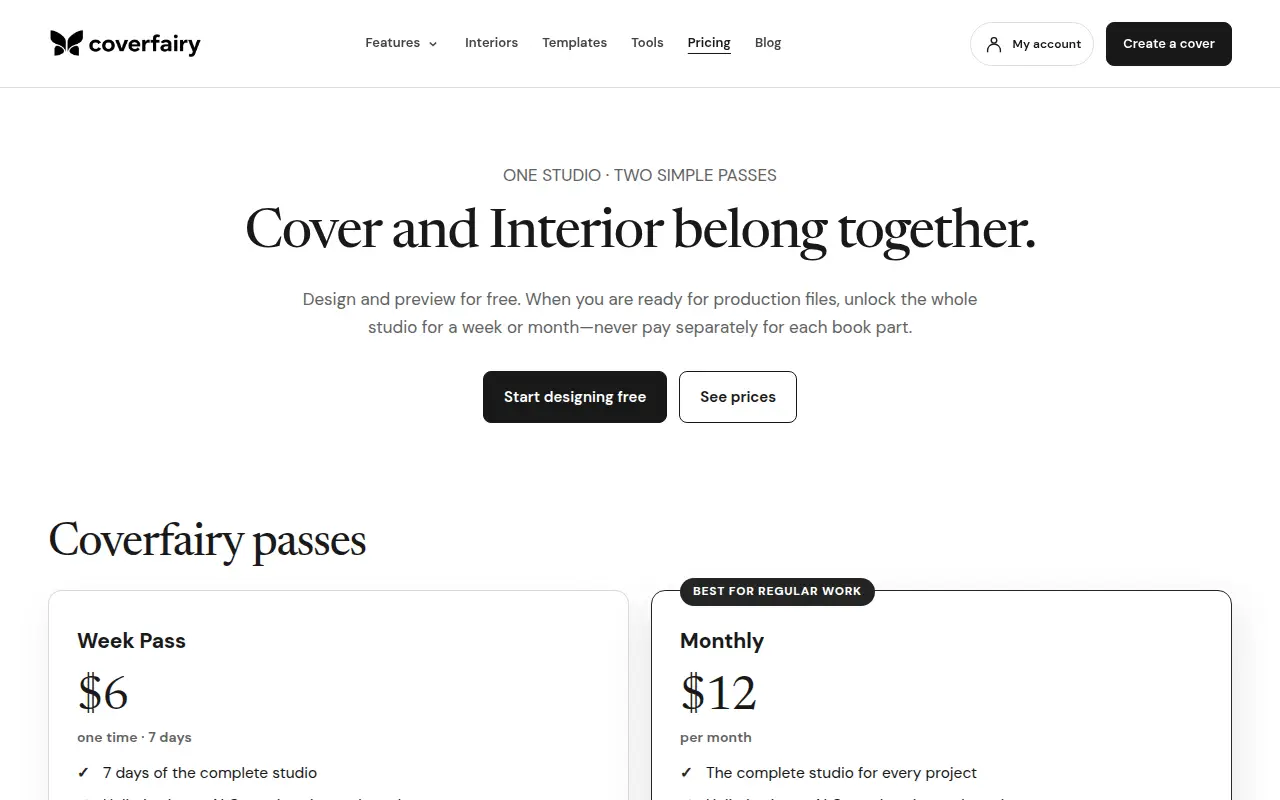
One delivered AI image, variation, or edit costs one credit. Asking for four directions costs four. Failed generations are not charged. Text, fonts, colours, and layout cost none. Both paid passes include the same exports; you pick duration and how many images you expect. The pricing page says you do not pay separately for cover and interior.
Guests can browse templates, upload artwork, edit the cover and manuscript, use planning tools, and inspect watermarked previews with no account. An account is what adds online saving and the four AI credits.
The features page says "4.9/5 from 100+ independent authors." That is a vendor figure. The fact sheet tells you not to treat a score as a guarantee of market fit.
Using it as a writer
- Write the title as type, not as part of the prompt. The product is built so a later subtitle change does not regenerate the painting.
- Preview the interior before you buy the pass. Import the manuscript, read the pages, and download a watermarked sample. The $6 pass is for the week you actually export.
- Use the official template for IngramSpark, Lulu, and Barnes & Noble. Coverfairy calculates KDP from the page count. The other three want the spine width from their own template. The fact sheet says the pricing page and checkout are controlling for entitlements, and the printer's template is controlling for dimensions.
- Spend credits on directions, not on typos. A font change is free. A new image is not.
- Keep the project. When the week ends, the files you already downloaded stay yours. The next full-resolution export needs access again.
Strengths
- Type and art are separate. That is the difference from an image model that paints the title into the pixels.
- Cover and interior share a page count, so the KDP spine is not a second project you update by hand.
- A $6 week is a real option if you have one book and do not want a subscription. Monthly is there if you are updating several projects.
- AI is optional. Upload licensed art and the rest of the workflow still runs.
- A written correction policy for a bad dimension calculation, and a fact sheet that lists what the product does not claim.
Writer's Toolbelt editorial scores
Coverfairy scorecard
7.4/10
- Editable covers8/10
- Interior formatting7/10
- AI artwork6/10
- Ease of use8/10
- Value for one book8/10
Weaknesses
- Full-resolution exports stop when the pass stops. Editing and watermarked previews remain. A later edition means paying again.
- Not a layout program. Photo books, textbooks, and fixed-layout children's books are out of scope. Poetry may need a manual pass.
- You still clear rights. Generated art is identified in the project. Identification is not a license opinion, and the fact sheet says so.
- IngramSpark, Lulu, and Barnes & Noble spines are only as good as the template you paste in.
- Canva handoff is a download, not a live link.
- Four free images, once. They do not refill. A week of experimenting beyond that is the $6 pass or the $12 month.
How it compares
- Coverfairy vs Canva. Canva is the general design app, with templates for social posts and a much wider AI allowance on paid plans. Coverfairy is the book: editable cover type, a calculated print wrap, and a typeset interior. The Canva export exists so you can keep going in Canva, not so Coverfairy replaces it. See the Canva review.
- Coverfairy vs Ideogram. Ideogram is an image model with a reputation for rendering words. Coverfairy's art page does the opposite on purpose: text-free art, type on top. Use Ideogram if you want a poster. Use Coverfairy if the file has to be a wrap. See the Ideogram review.
- Coverfairy vs Midjourney. Midjourney is a picture generator with no interior formatter and no KDP spine. Coverfairy will call an image model, then do the publishing files. See the Midjourney review.
- Coverfairy vs Leonardo. Leonardo is another image studio. It does not typeset a manuscript or build an ACX square from a print cover. See the Leonardo review.
Feature comparison
AI image and cover tools compared
| Feature | Adobe Firefly | Ideogram | Midjourney | Leonardo.Ai | Canva Magic Studio | Coverfairy |
|---|---|---|---|---|---|---|
| Free plan | Yes | Yes | No | Yes | Yes | Yes |
| Lowest listed paid price | Yes$10 | Yes$15 | Yes$8 | Yes$12 | YesUS$12/mo equiv.; prices vary by region | Yes$6 for 7 days |
| All paid tiers have published prices | PartlyPro Plus dollar amount: check vendor site | PartlySome tiers: contact sales or check vendor site | Yes | Yes | PartlySome tiers: contact sales or check vendor site | Yes |
| Competes with ProseEngine (we disclose) | No | No | No | No | No | No |
Verdict
Coverfairy is a finishing tool, not a writing tool. The useful idea is that the title stays editable and the interior's page count can set the spine. For one book, the $6 Week Pass is the sane purchase: design and preview free, pay in the week you export, and do not leave a subscription running.
Start without an account if you only want to see the editor. Create the free account when you want the four images saved. If the watermarked interior looks like your book, buy the week. If you are revising covers every month, the $12 plan is the one that refills 40 credits.
FAQ
Can I use Coverfairy for free? Yes. Guests can edit and preview with a watermark. A free account adds online saving and 4 one-time AI image credits. No card. Full-resolution publishing files need a pass.
How much does it cost? On 16 October 2026, the Week Pass was $6 for 7 days with 20 AI credits and no renewal. Monthly was $12 with 40 AI credits per billing period. Both unlock cover and interior exports while they are active.
Do I have to use AI art? No. Upload art you have the rights to, or start from a suggested image. A new AI image is what spends a credit.
Which files do I get? With an active pass: ebook cover, print wrap, ACX square, mockups, Canva-ready PPTX or PDF, EPUB, print-interior PDF, and large-print PDF. Free cover drafts are watermarked.
Is Coverfairy part of Amazon or Canva? No. The about page and the fact sheet say it is independent and builds files from those companies' published requirements.
Free guide
The 10 best free AI tools for writers
Join the Writer's Toolbelt newsletter for a short note when the shelves change, and get the free PDF guide.
Nearby on the shelf
Audiobooks and covers
Adobe Firefly
Generative image tools trained with an eye on licensed stock, and wired into Photoshop. That does not make every output a cleared book cover, but the paper trail is easier to explain to a publisher than a random model checkpoint. The pictures can look like stock. Sometimes that is what a nonfiction cover wants.
Best for Authors already in Photoshop who want generative fills and a more legible commercial story.
FreemiumFiction and nonfictionAudiobooks and covers
Canva Magic Studio
Templates, Magic Media images, and Magic Write copy in the same place you will actually export a paperback wrap or an Instagram square. The risk is the Canva look: competent, familiar, and easy to spot. A fine way to ship a decent ebook cover or launch graphic if you push past the first template.
Best for Authors who need a workable cover, social graphics, and a blurb draft without hiring a designer yet.
FreemiumFiction and nonfictionAudiobooks and covers
Descript
Edit recorded audio by editing the transcript. Cut a retake by deleting a sentence. Overdub can patch a flubbed word in your own voice, which is either a gift or a temptation depending on how honest the recording should stay. Built for people who record themselves, not for fully synthetic casts.
Best for Authors who record their own audiobook or podcast and want to edit sound the way they edit a document.
FreemiumFiction and nonfiction