Getting words down
DreamGen
A story and role-play generator. You keep a scenario (the docs also call it a story bible) and steer the next passage with instructions. Plans meter credits and context. The pricing-page callouts name Gemma 4 26B as the basic model and GLM 5.2, GLM 4.7, and Gemma 4 31B as premium. It is built to continue a scene, not to export a typeset manuscript.
Best for
Fiction writers who want a steerable story generator and a scenario they can edit while the draft grows.
Pricing
Freemium. Free tier with limited credits. On 26 October 2026 the monthly list prices were still Starter $7.83, Advanced $19.35, and Pro $48.30, with a first-month discount to $6.26, $15.48, and $33.81. No annual price was on the pricing page.
Checked 26 October 2026. Plans move. The vendor's page wins an argument with this one.
Good to know
At a glance
- Availability
- not stated
- Platforms
- The privacy policy says the website and associated apps.
- Languages
- not stated
- Launched
- Launched not stated
- Independent reviews
- Third-party reviews exist, including RoboRhythms (updated 22 October 2026).
- AI training and retention
- Does not train on stories unless you opt in. The control is off by default. Withdrawal stops new use, not weights already trained. Some requests go to third-party providers under their policies.
In-depth review
DreamGen review
Last checked 26 October 2026 against the vendor's public pages. Prices and features change; check the vendor before you buy.
Disclosure: The person who runs Writer's Toolbelt also makes ProseEngine, an AI fiction-writing app that competes with DreamGen. This review sticks to verifiable facts and links its sources below.
Writer's Toolbelt review
DreamGen
A steerable story and role-play generator, with a scenario the docs also call a story bible. Credits and context depend on the plan.
- free tier, limited credits
- Starter list price per month
- tokens of context on the Pro card
What it is
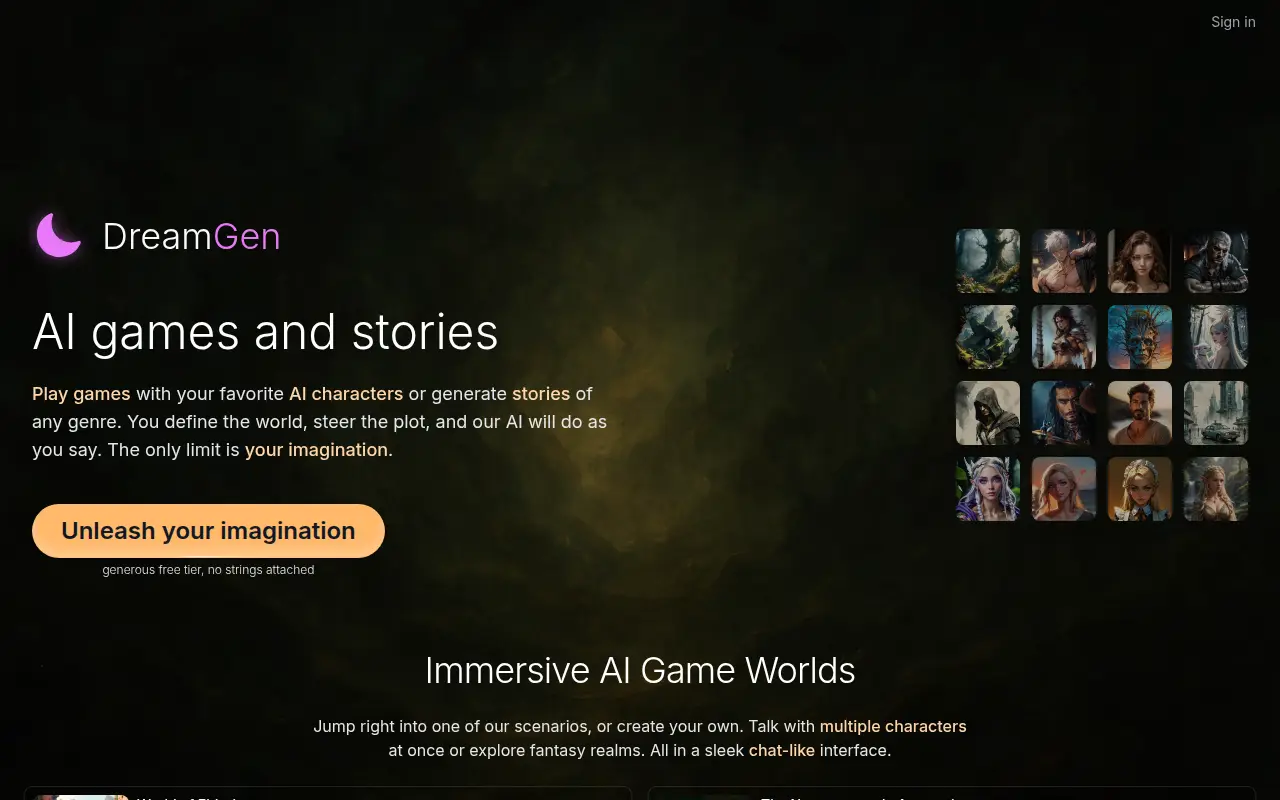
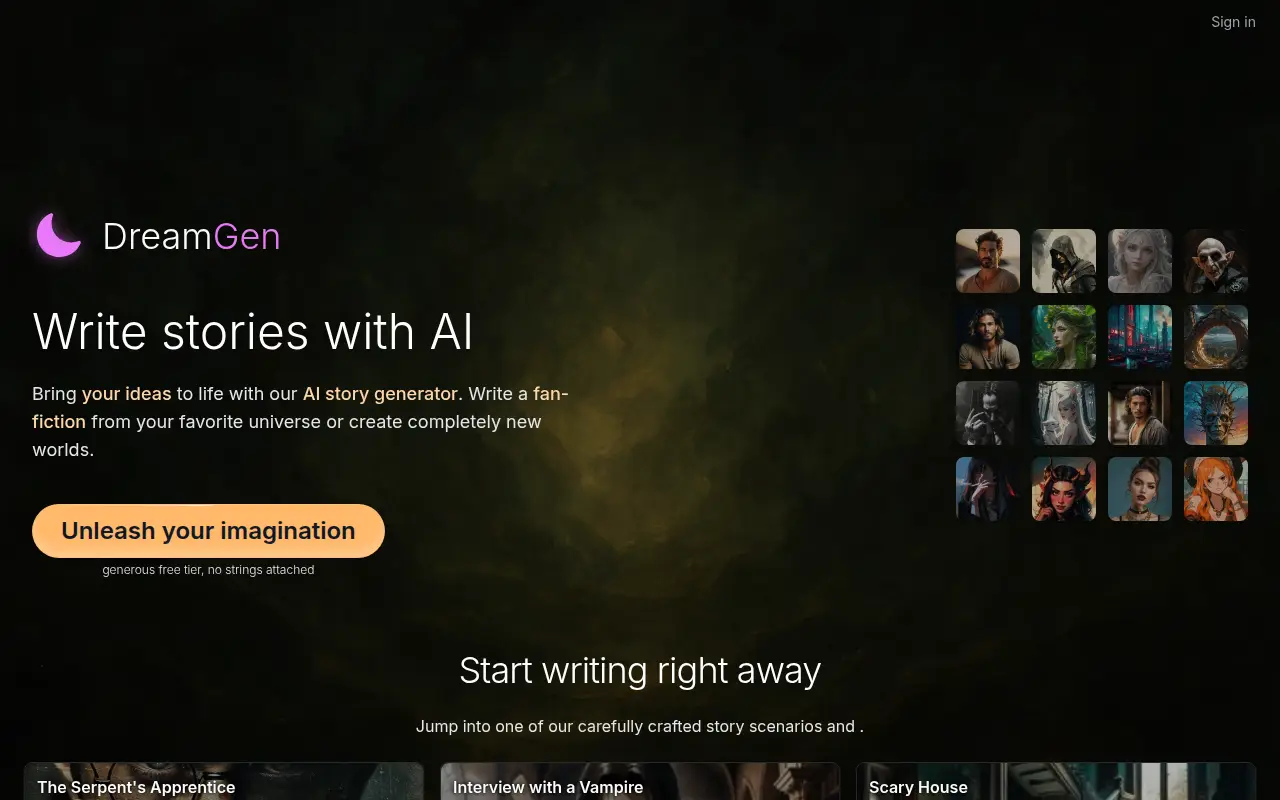
DreamGen is a browser app for AI stories and role-play. The home page leads with games: you step into a scenario, talk to characters, and steer what happens. A section under that says if you would rather write than play, the story generator is the other door. The story page calls it a way to write fan fiction or a world of your own. Both pages say there is a generous free tier with no strings attached.
This is not a Word processor with a grammar pass. The writing docs describe a session of text blocks, some written by you and some by the model, plus instruction blocks that tell the model what the next passage should do. The public docs we read do not describe a DOCX or EPUB export. Check the vendor site if a typeset manuscript file is the requirement.
The company line on the story page is a vendor figure: 20,000+ engaged users and 100,000+ stories and role-plays. We did not verify the count.
Who it's for
- Fiction writers who want the next scene generated inside a world they defined, and who will edit the result. The docs tell you to click into any block, including the model's, and rewrite it.
- People who already like interactive role-play and sometimes switch that scenario into Story Mode. The docs say a role-play scenario can be used for a story if you switch modes during setup.
- Writers who want an unfiltered fictional range. The terms say content on the service is intended to be fictional, ban sexual content involving minors, and require you to be 18.
It is a weak fit if you want a manuscript desk with chapter navigation, a human-editor report, or a file a formatter can open. Those jobs are not what the pages we read are selling.
Key features in practice
- A scenario, also called a story bible. The writing guide says a story scenario is the context the model uses. The elements it names are plot, setting, style, characters, locations, objects, an opening, and examples. Most of them are optional. Each writing session gets its own copy of the scenario, which you can edit while you write so a changed character or a new plot turn stays in the brief. On a desktop that editor is in the sidebar.
- Continue, rewind, undo, and instructions. Continue writes the next section from the scenario and the story so far. Rewind regenerates. Undo removes the last generation. An instruction block is a director's note: the docs' examples include a flashback, a word-count cap, and a character action. A Writing Assistant can be asked to rewrite a part. The story auto-saves.
- Choose-your-own-opening. Some scenarios offer more than one opening, or ask you to pick a protagonist from the scenario author's personas, your own templates, or a new one.
- Models, and they move. On 26 October the pricing cards' own popovers named the current basic model as Gemma 4 26B and the current premium models as GLM 5.2, GLM 4.7, and Gemma 4 31B. The third-party popover says those models include DeepSeek V4 Pro, GLM 5.3, Muse Spark, Kimi, MiMo, and others. The writing guide's examples are still GLM 5.2, GLM 4.7, Gemma 4 31B, and Gemma 4 26B A4B, and it still says the lineup changes. Lucid Base and Lucid Max are still described on the page as legacy models, no longer recommended. The same page describes Mistral Large 4 as retiring after 27 October 2026, with a launch discount of 62.5% off until then.
- Images. The docs include a guide to generating images. The credits FAQ says image cost is shown before you generate. Unlimited text, where a plan has it, does not make images free. The "which models" answer says Pro still pays credits for images.
- Two products in one subscription. Role-play is a chat with characters. Story mode is the writing interface. You can publish a scenario. That is a community feature, not a bookshop.
Pricing (checked 26 October 2026)
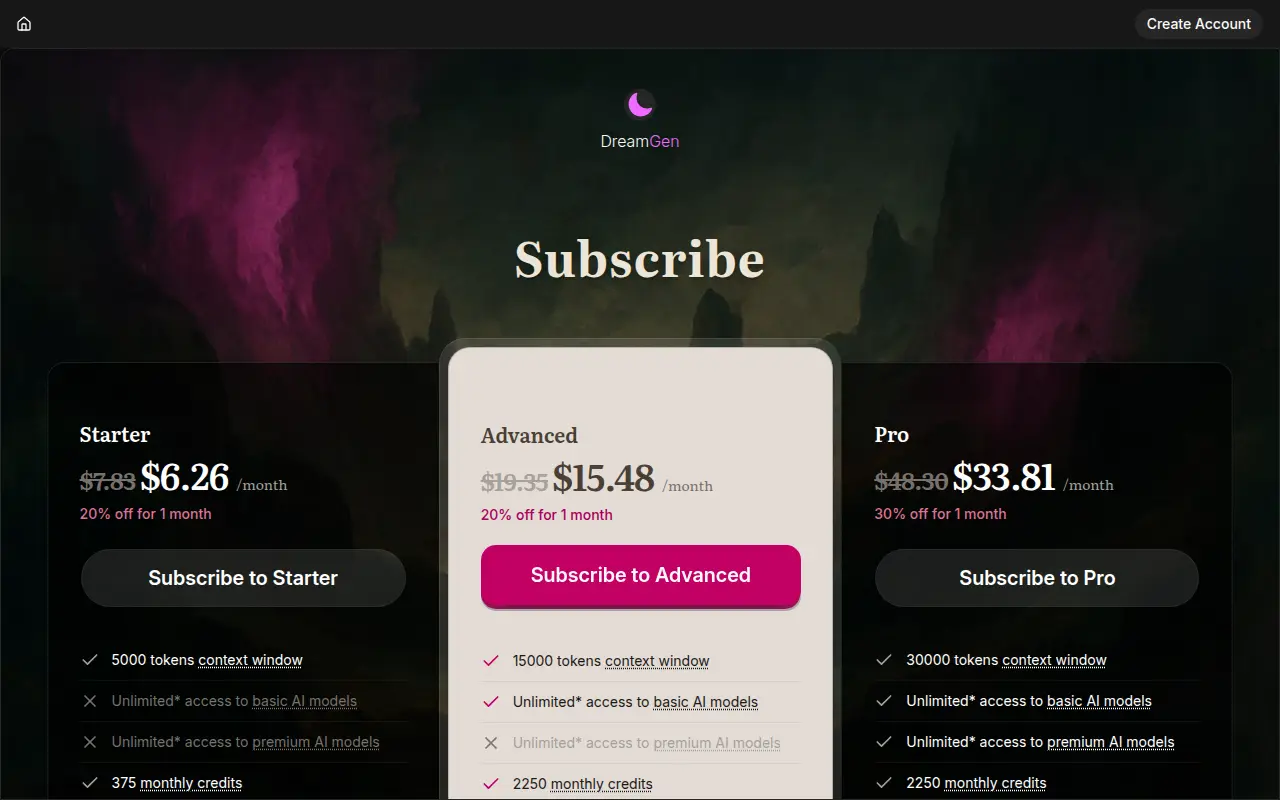
The pricing page at v2.dreamgen.com/pricing shows three paid cards, billed monthly. Each card prints a struck list price and a larger discounted price, with a line that says the discount is for one month. There is no annual plan on the page.
| Plan | List price | First month on the card | What the card marks as included |
|---|---|---|---|
| Free | $0 | $0 | All current models, the FAQ says, with limited monthly and daily credits. The free credit count is not printed in that answer |
| Starter | $7.83 | $6.26 (20% off for 1 month) | 5,000-token context on the card. 375 monthly credits and 45 extra daily credits. Unlimited text is marked off |
| Advanced | $19.35 | $15.48 (20% off for 1 month) | The card says 15,000 tokens. Unlimited access to basic text models is on. Unlimited premium text is off. 2,250 monthly credits and 75 extra daily credits |
| Pro | $48.30 | $33.81 (30% off for 1 month) | The card says 30,000 tokens. Unlimited basic and premium text are both on. Same 2,250 monthly and 75 daily credits as Advanced. 20% off credit packs, and up to 60% off select third-party models |
Pricing at a glance
- FreeAll current models, limited credits; context depends on the modelFree
- StarterFirst month $6.26. 5,000-token card. 375 monthly credits$7.83/mo
- AdvancedFirst month $15.48. Unlimited on smaller text models$19.35/mo
- ProFirst month $33.81. Unlimited on current text models$48.3/mo
Read the popovers next to the cards, because the headline context number is not every model. On 26 October the Starter popover said 5,000 tokens is about 20,000 letters. The Advanced popover said Advanced users have a 15,000-token window with Gemma 4 26B. The Pro popover said Pro users have 30,000 tokens with GLM 5.2 and 60,000 with Gemma 4 31B. The plan data on the same page still lists 8,000 tokens for several larger first-party models on Advanced, including GLM 4.7, GLM 5.1, GLM 5.2, GLM 5.3, and Gemma 4 31B, and 15,000 for Gemma 4 26B A4B and Qwen 3.5 27B. The card's single "15,000" or "30,000" is a headline, not the whole table.
The same FAQ says which unlimited flag applies. Gemma 4 26B A4B, Lucid Base, and Qwen 3.5 27B are unlimited for Advanced and Pro. Gemma 4 31B, GLM 4.7, GLM 5.2, and Lucid Max are unlimited for Pro. Free and Starter pay credits for every model. Advanced pays credits for the larger text models and for images. Pro pays credits for images. "Unlimited" means the credit cost of those text models is zero, with a fair-use note against bots, account sharing, and reselling.
Credits are the meter for text and images. The FAQ says a text charge depends on the model, how long the story already is, how long the reply is, and the plan. One token is about four characters, and the page's own illustration is that 30,000 tokens is about a 100-page book of context, not 100 pages of free generation. Monthly and daily allowances do not roll over. Purchased credit packs, available only to subscribers, are used after the recurring allowance and are the part that is not on that reset. Daily credits are a small allowance that starts only after the monthly allowance is used up. When a subscription ends, limits drop to the free tier immediately.
Cancel from Account, then Billing. The FAQ says the plan stays on until the period ends and that cancelling does not itself refund you. A different FAQ answer says they offer prorated refunds if you email refunds@dreamgen.com, judged on days left, credits used, and whether you have asked before. The terms, updated 23 March 2026, say purchases are final except where the law requires a refund or the company chooses to give one. Those three sentences are all on the site. Read them together before you pay.
Writer's Toolbelt editorial scores
DreamGen scorecard
6.2/10
- Story steering8/10
- Scenario and continuity7/10
- Manuscript workflow4/10
- Price clarity6/10
- Fit for a long novel6/10
Strengths
- The scenario is editable in the session. The guide is explicit that the plot and the character notes can be updated when the story turns, and that the model is supposed to use that copy.
- Steering is a first-class control, not a hope that the chat remembers a sentence you typed an hour ago. Instructions, rewind, and hand edits are all in the writing guide.
- A real free tier, with access to current models. The limit is credits and context, not a locked demo.
- Training is opt-in. The privacy policy says story and role-play data is not used to train models unless you turn that on. It is off by default. Withdrawing consent stops new use. Data already used is not pulled back out of a trained model. The terms still grant a licence to operate and improve the service. That is a different sentence from the training switch. Read both.
- You keep what you generate. The terms say the service does not claim ownership or copyright of user content, and that you may use it within ordinary intellectual-property law. They also say they do not promise the output is copyrightable.
Weaknesses
- The price and the context size are each told twice. The card headline and the popover do not give one context number for every model on Advanced or Pro. Use the number next to the model you select.
- Credits still apply on the plans that are not "unlimited" for the model you picked, and images cost credits even on Pro. The page does not convert a credit into a word count.
- No manuscript export in the docs we read. The story lives in Your Stories.
- Models are withdrawn. Lucid Base and Lucid Max are already marked legacy. The terms say a model can disappear and that a refund is not owed when it does.
- The first-month price is not the renewal price. $6.26, $15.48, and $33.81 are the discounted first month. The list prices are $7.83, $19.35, and $48.30.
- Fan-fiction scenarios on the marketing page use other people's characters. The terms put copyright risk on you. A Harry Potter scenario on the story page is not a licence.
How it compares
- DreamGen vs NovelAI. Both are story generators with their own models and a lore record, and both are comfortable with fiction that mainstream chat tools refuse. NovelAI publishes image generation in the same subscription and a context size on the plan table. DreamGen splits text and images, and the context size depends on the model as well as the plan. See the NovelAI review.
- DreamGen vs Sudowrite. Sudowrite is a manuscript studio: Write, Describe, Rewrite, and a Story Bible, on a credit subscription. DreamGen's writing surface is a stack of passages and instructions, closer to a steered generator than to a chapter editor. See the Sudowrite review.
- DreamGen vs Type. Type is a document editor with Notes, offline mode, and a Word export. DreamGen is the generator. If the job is the file, Type is the closer tool. See the Type review.
- DreamGen vs ProseEngine. ProseEngine is made by the person who runs this site. See the disclosure above. It is also a fiction studio with a codex and scene generation. We are not scoring that matchup. Read both product pages and run the same scene in each if you want a comparison that is yours.
Feature comparison
AI fiction drafting tools compared
| Feature | NovelAI | Squibler | Type.ai | Storysnap | ProseEngine | DreamGen |
|---|---|---|---|---|---|---|
| Free plan | Yes | Yes | Yes | No | Yes | YesLimited credits; the free credit count is not printed in the FAQ answer |
| Lowest listed paid price | Yes$10 | Yes$15.83 | Yes$8 | Yes$45 | Yes€8 | Yes$7.83 |
| All paid tiers have published prices | Yes | Yes | Yes | Yes | Yes | Yes |
| Competes with ProseEngine (we disclose) | Yes | Yes | Yes | Yes | Yes | Yes |
Verdict
DreamGen is a story generator with a scenario you can edit and instructions that are supposed to bind the next passage. That is a real writing tool, and the free tier is enough to see whether the prose is yours. It is not a book studio. The card and the FAQ disagree on context size, the first month is cheaper than the renewal, and nothing we read hands you a Word file.
Use the free tier on a scene you can judge. If you pay, price the renewal ($7.83, $19.35, or $48.30), not the struck-through first month, and read the context table for the model you actually select.
Noted on 26 October 2026
List prices and the first-month discounts were unchanged from 22 October: Starter $7.83 ($6.26), Advanced $19.35 ($15.48), Pro $48.30 ($33.81). Unlimited text is still off on Starter, on for basic models only on Advanced, and on for basic and premium text on Pro. Images still cost credits on Pro.
The privacy policy, re-read the same day, still says story and role-play data is not used to train models unless you opt in, that the switch is off by default, and that the service is for people who are at least 18 and the age of majority where they live (https://dreamgen.com/privacy). The about page does not give a launch date. The blog's newest posts on 26 October were comparison articles dated 25, 17, and 15 September 2026, not a product changelog.
FAQ
Is DreamGen free? Yes. The pricing FAQ says the free tier includes current models, limited monthly and daily credits, and a basic context window. It does not print the free credit count in that answer. Check the vendor for the number.
How much is Starter? On 26 October 2026 the list price was still $7.83 a month. The card showed $6.26 for the first month, labelled 20% off. It is billed monthly. There was no annual price.
Does DreamGen train on my stories? The privacy policy says no, unless you opt in. That switch is off by default. Content already used while you had consented is not removed from existing model weights.
Who owns the story? The terms say the service does not claim ownership of what you generate. They also say they do not promise that AI output is copyrightable, and you are responsible for what you publish.
What happens to credits if I cancel? The FAQ says you keep the plan until the period ends, and that when the subscription expires the limits revert to the free tier immediately. Monthly and daily allowances do not roll over. Credit packs are separate.
Free guide
The 10 best free AI tools for writers
Join the Writer's Toolbelt newsletter for a short note when the shelves change, and get the free PDF guide.
Nearby on the shelf
Drafting
AuthorFlows
A browser studio for novels: an outline generator, a paginated editor, character cards, a story map, a timeline, and a Story Analyzer you run on purpose. The home page says the manuscript is never used to train a model, and that you can turn generation off. There is no free plan on the pricing section. The privacy policy and terms on the site say they take effect on 16 November 2026.
Best for Fiction writers who want outline, cast, and a chapter editor in one browser tab, and who will pay before they can try a manuscript.
SubscriptionFictionDrafting
ChatGPT
The general assistant most writers already have open. Useful for brainstorming, blurb variants, and line rewrites if you paste the scene and say what you want. It does not hold a novel together unless you build that memory yourself with projects or files, and it will invent sources if you let it.
Best for Writers who want one flexible assistant and will bring their own outline, pages, and skepticism.
FreemiumFiction and nonfictionDrafting
Claude
A general assistant that writers often prefer for long passages, tone, and a calmer revision pass. Projects can hold notes and chapters you upload. It is still a chat, not a novel app: continuity across a whole book is only as good as the pages you put in front of it.
Best for Drafting and revision when you want a careful reader more than a plot machine.
FreemiumFiction and nonfiction