After the draft exists
Fictionary
Story-structure software that visualizes a story arc and includes Edwina, an AI instructor for scene-level feedback. The useful part is seeing whether the draft has a shape. The classes, if you buy them, are people. Do not confuse the two.
Best for
Novelists who want structure feedback while outlining and revising, with an optional human class on the side.
Pricing
Subscription. Software subscription for StoryTeller. Higher plans add live classes with human editors, which are not the AI.
Listing checked 14 October 2026. Plans move. The vendor's page wins an argument with this one.
In-depth review
Fictionary review
Last checked 14 October 2026 against the vendor's public pages. Prices and features change; check the vendor before you buy.
Disclosure: The person who runs Writer's Toolbelt also makes ProseEngine, an AI fiction-writing app that competes with Fictionary. This review sticks to verifiable facts and links its sources below.
Writer's Toolbelt review
Fictionary
Story-structure editing software: scene-by-scene insights on plot, character and setting, from a company built around developmental editing.
- StoryTeller per month
- day free trial, no card
- of writers stuck in the middle (vendor survey)
What it is
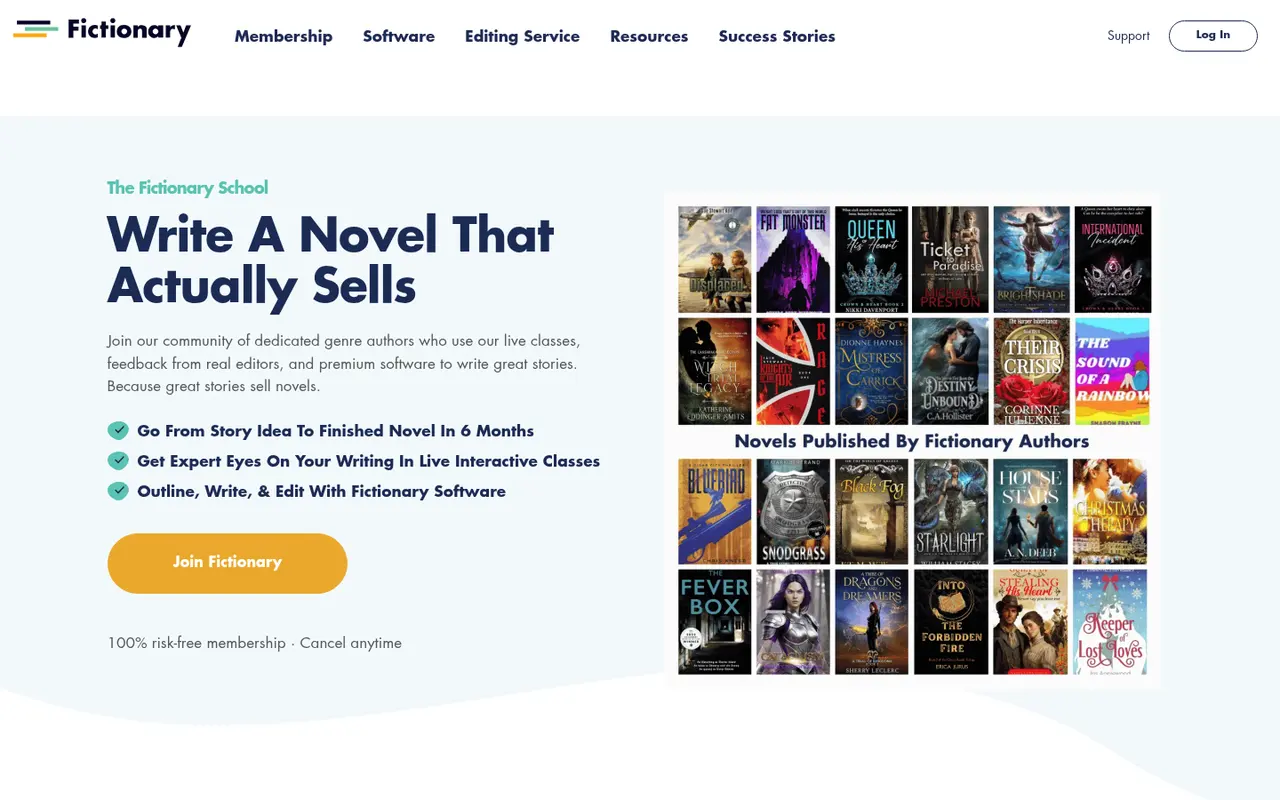
Fictionary is story-structure software for fiction writers, from a company that also runs a membership "school" with live classes and an editing service. The software analyses your manuscript scene by scene and gives "plot, character, & setting insights" plus "immediate AI-powered story feedback". The aim is developmental editing, the big-picture work that grammar tools don't touch.
Who it's for
- Genre novelists in revision. The site names mystery, romance, fantasy, sci-fi and thrillers.
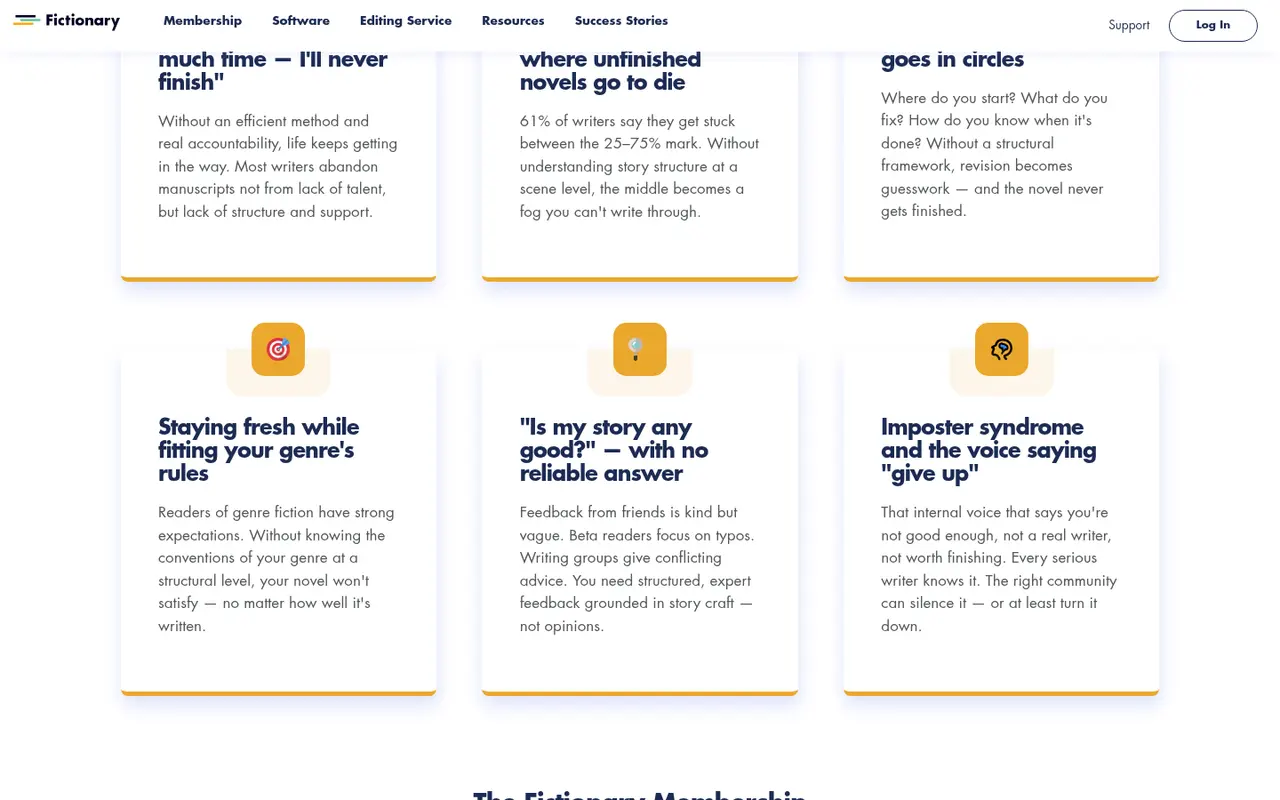
- Writers stuck in "the messy middle". Fictionary cites its own survey: "61% of writers say they get stuck between the 25–75% mark."
- Freelance developmental editors. StoryCoach is built for editors working with up to 20 clients at once.
It's not for proofreading or line editing.
Key features in practice
- Plot, character and setting insights. The pricing page lists these as the core of every plan. The home page frames the goal as understanding "story structure at a scene level".
- Outline, write and edit. The home page says the software covers outlining, writing and editing, not just analysis.
- AI story feedback on plot, character and setting.
- Premium extras. Track changes and comments, and support for series.
- StoryCoach for editors: all Premium features plus client management.
- Membership. Live classes and feedback from real editors, sold separately from the software.
Pricing (checked 14 October 2026)
| Plan | Price shown | For |
|---|---|---|
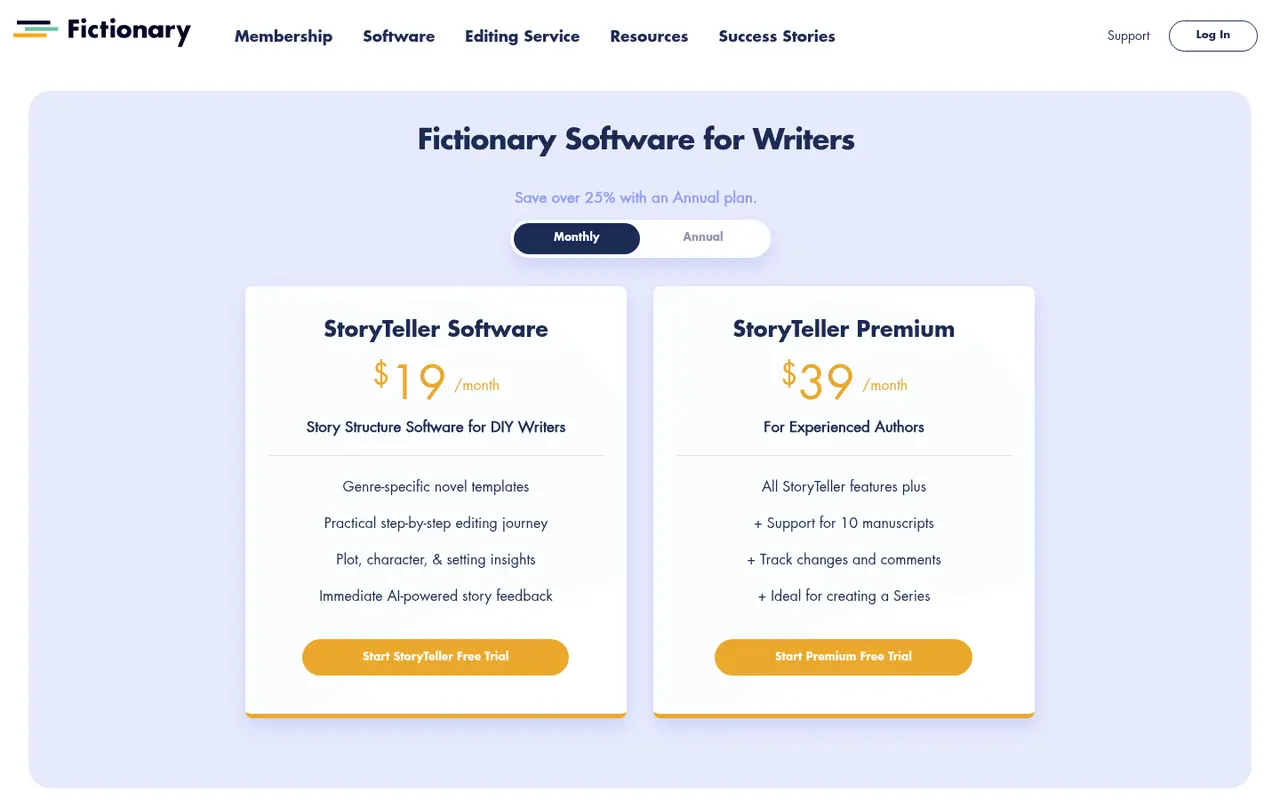
| StoryTeller | $19/month | DIY writers: plot, character and setting insights, AI story feedback |
| StoryTeller Premium | $39/month | Experienced authors: adds track changes, comments, series |
| StoryCoach | $49/month | Editors: 20 clients, all Premium features |
All plans are in USD and include a 7-day free trial with no credit card. The page offers "over 25%" savings on annual plans, so check which billing period your price reflects.
Pricing at a glance
- StoryTellerPlot, character & setting insights; AI story feedback$19/mo
- StoryTeller PremiumAdds track changes, comments, series$39/mo
- StoryCoach (editors)Support 20 clients at a time$49/mo
Using it as a writer
- Finish the draft first. Structural analysis needs a full story to analyse.
- Work scene by scene. Fictionary's approach is built around scene-level structure, so make sure your manuscript's scene breaks are clear before you import it.
- Look for patterns across the book, such as a sagging middle or characters who disappear for long stretches, rather than fixing scenes one at a time.
- Revise structure before sentences. Fix the scene order and the arc, then use a line-level tool such as ProWritingAid or AutoCrit.
- Use the 7-day trial on a real manuscript. Block out time that week so the trial isn't wasted.
Strengths
- True developmental focus, which is rare among software tools.
- Structure-first insights make big-picture problems easier to see.
- No-card free trial.
- An editor plan that lets professionals work with their clients in the same tool.
Writer's Toolbelt editorial scores
Fictionary scorecard
7.4/10
- Structural (developmental) feedback9/10
- Line-level editing4/10
- Fiction focus10/10
- Ease of use7/10
- Value for money7/10
Weaknesses
- Learning curve. A structural method takes time to learn and apply.
- Not a line editor.
- Monthly pricing adds up over a long revision, and annual billing saves money.
How it compares
- Fictionary vs AutoCrit. AutoCrit is stronger at prose-level analysis. Fictionary is stronger at story structure.
- Fictionary vs Marlowe. Marlowe produces a one-off AI report on a manuscript. Fictionary is an interactive workspace.
- Fictionary vs StorySnap. Both target story feedback. Compare their approaches on the same chapter.
Feature comparison
Manuscript feedback tools compared
| Feature | AutoCrit | Fictionary | Marlowe | DeepL Write |
|---|---|---|---|---|
| Free plan | Yes | No | Yes | Yes |
| Lowest listed paid price | Yes$15 | Yes$19 | Yes$29.95 | Yes$8.74 |
| All paid tiers have published prices | Yes | Yes | Yes | Yes |
| Competes with ProseEngine (we disclose) | Yes | Yes | Yes | No |
Verdict
If your draft is finished but "doesn't work" and you can't say why, Fictionary is the most structure-focused tool here. Pair it with a line editor for the sentence-level pass.
FAQ
Does Fictionary have a free trial? Yes. All plans include a 7-day free trial with no credit card.
How much is Fictionary? On 14 October 2026 the page showed StoryTeller at $19, Premium at $39 and StoryCoach at $49 per month, with annual savings of over 25%.
Is it for nonfiction? No. It is built around fiction story structure.
Nearby on the shelf
Editing
AutoCrit
Fiction editing reports for dialogue, pacing, repetition, and overused phrasing, plus a story analyzer and an AI reader you can steer with instructions. The reports compare your draft with genre tendencies, which is a clue, not a verdict. It will not write the book for you.
Best for Novelists who want genre-aware notes on a complete draft, not a chatbot that continues the scene.
SubscriptionFictionDrafting
Claude
A general assistant that writers often prefer for long passages, tone, and a calmer revision pass. Projects can hold notes and chapters you upload. It is still a chat, not a novel app: continuity across a whole book is only as good as the pages you put in front of it.
Best for Drafting and revision when you want a careful reader more than a plot machine.
FreemiumFiction and nonfictionEditing
DeepL Write
Rewrite suggestions from the company behind DeepL translation. It is aimed at clearer phrasing, not plot. Particularly useful if you draft between languages or want a second wording that is conservative rather than clever. It will happily smooth a sentence that was supposed to be sharp.
Best for Nonfiction clarity, and writers moving between languages who want phrasing help rather than a story engine.
FreemiumNonfiction