Sources, not vibes
Scite
Shows whether later papers support, mention, or dispute a citation, instead of treating a reference list as applause. That is the right question for nonfiction that cannot afford a sloppy source. It is an academic tool with academic pricing instincts, and it will not draft your chapter.
Best for
Nonfiction that depends on knowing whether a cited paper is still standing.
Pricing
Freemium. Limited free lookups. Paid plans are aimed at researchers who need citation context at volume.
Listing checked 14 October 2026. Plans move. The vendor's page wins an argument with this one.
In-depth review
Scite review
Last checked 14 October 2026 against the vendor's public pages. Prices and features change; check the vendor before you buy.
Writer's Toolbelt review
Scite
Research AI with Smart Citations, which show whether later papers support or contradict a finding.
- full-text scholarly articles read (vendor figure)
- Basic per month, billed yearly
- day free trial
What it is
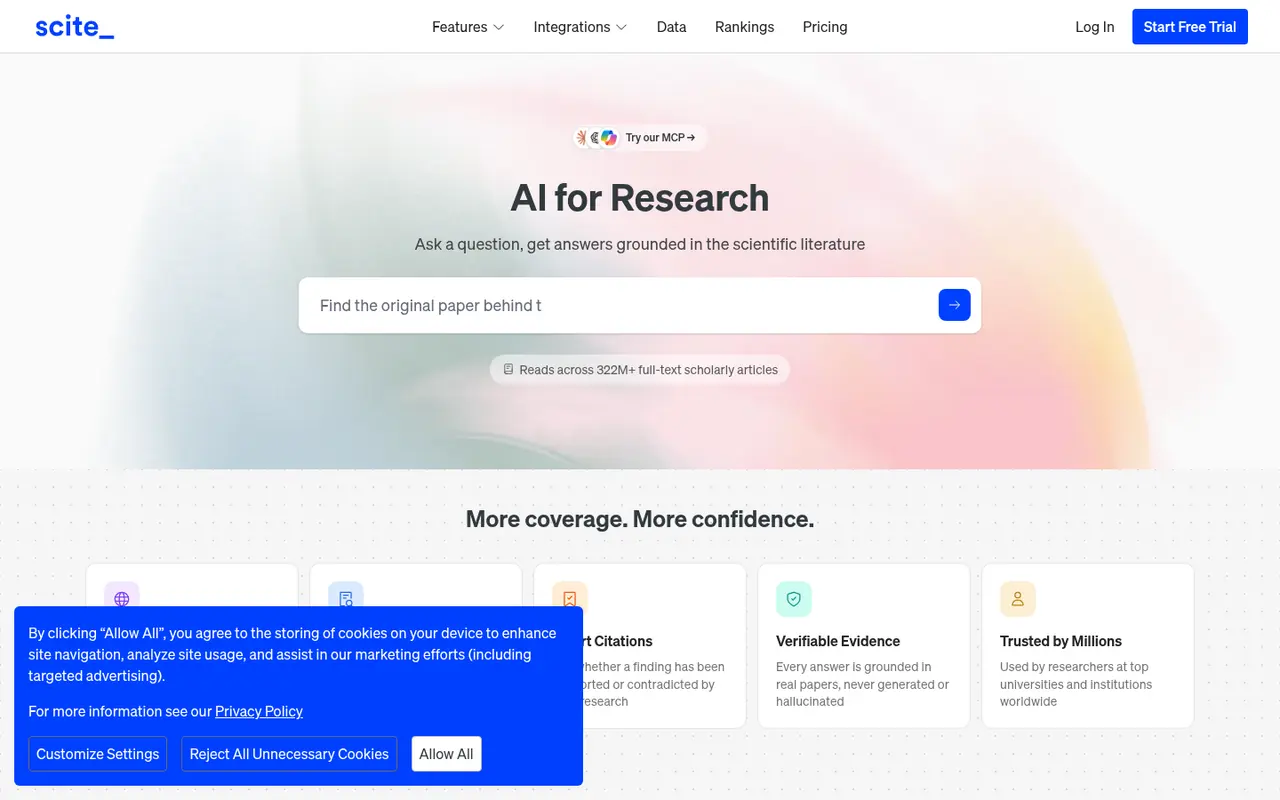
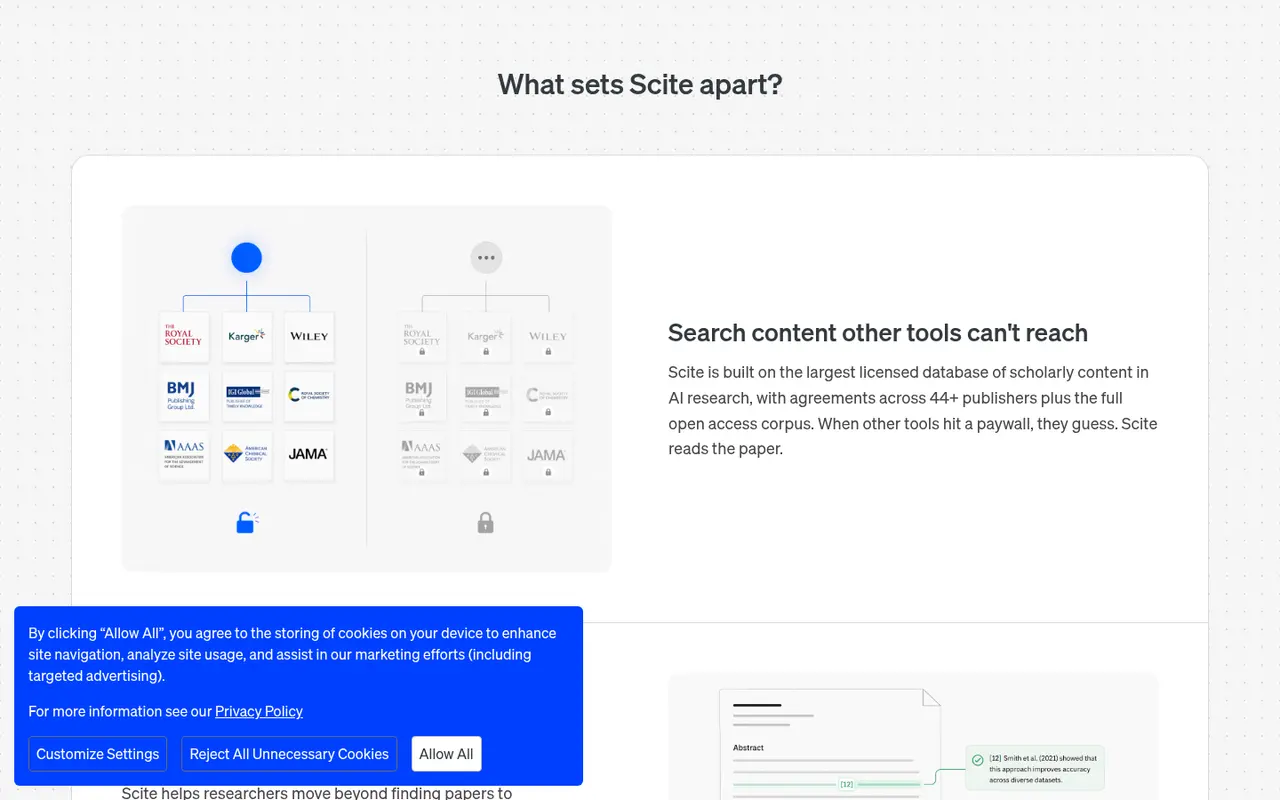
scite is "AI for research": ask a question, "get answers grounded in the scientific literature". It reads "across 322M+ full-text scholarly articles" and searches "300M+ articles, preprints, books, patents, and datasets". Its signature feature is Smart Citations: "see whether a finding has been supported or contradicted by later research." It says it is built on licensing agreements with Wiley, SAGE and 42+ more publishers.
Who it's for
- Nonfiction authors who need to know whether a study still holds up.
- Science and health writers, and fact-checkers.
Key features in practice
- Assistant. Answers grounded in real papers. scite says they are "never generated or hallucinated".
- Full-text search beyond abstracts.
- Smart Citations: supporting and contrasting citation context.
- Smart Citation reports for individual articles.
- MCP and API access: 250 MCP credits a month on Basic, and 2,500 plus API access on Pro.
- Collections of up to 10,000 papers, and patent, clinical-trial and grant datasets, on Pro.
Pricing (checked 14 October 2026)
| Plan | Price | Includes |
|---|---|---|
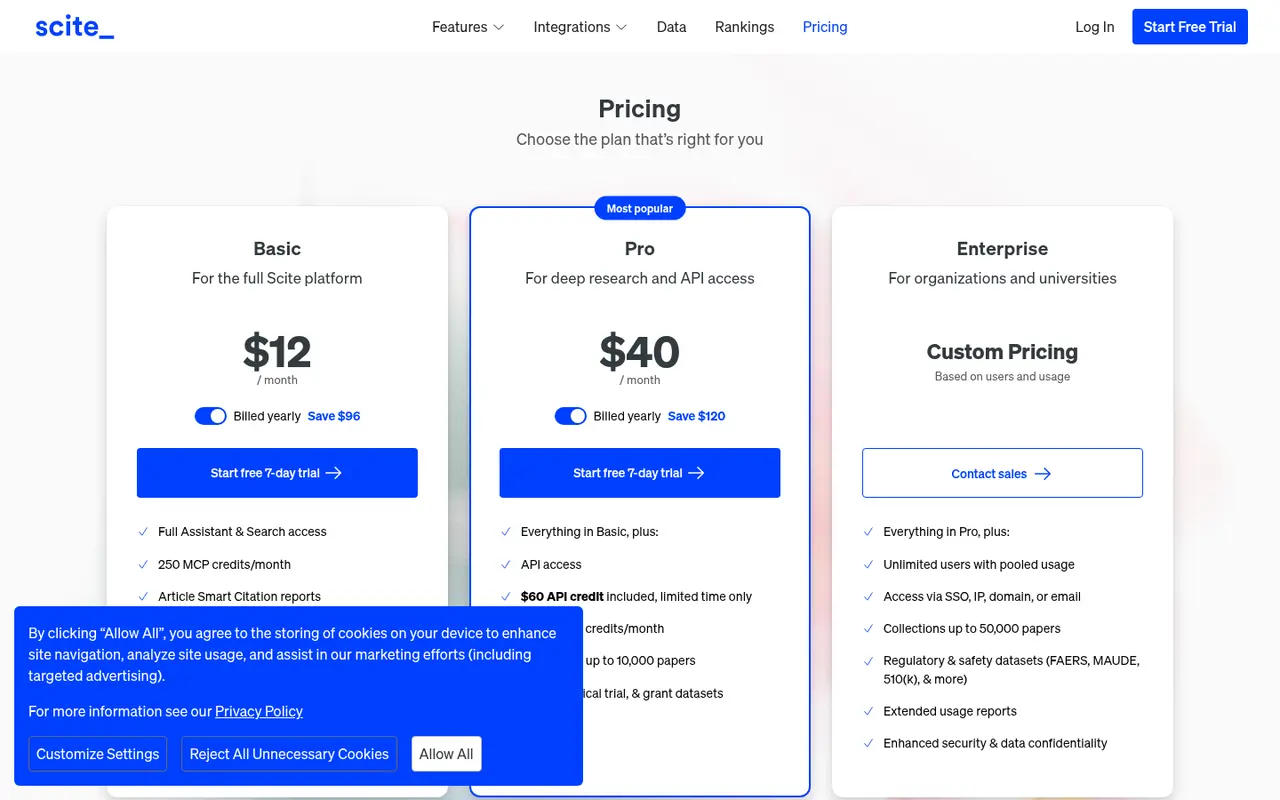
| Basic | $12/month billed yearly | Full Assistant and Search, 250 MCP credits/month, article Smart Citation reports |
| Pro | $40/month billed yearly | API access, 2,500 MCP credits, collections, datasets |
| Enterprise | Contact sales | Organisations |
There's a 7-day free trial. The page shows yearly savings of $96 (Basic) and $120 (Pro).
Pricing at a glance
- BasicFull Assistant & Search, 250 MCP credits$12/mo
- ProAPI access, 2,500 MCP credits, datasets$40/mo
- Enterprise
Contact sales
Using it as a writer
- Check your key claims. For each study you cite, look at whether later work supports or contrasts it.
- Use the Assistant to find papers, then read them.
- Note contested findings in your text. Readers appreciate honesty about uncertainty.
Strengths
- Unique evidence-strength view.
- Licensed full-text access.
- Affordable Basic plan.
Writer's Toolbelt editorial scores
Scite scorecard
7.2/10
- Evidence checking10/10
- Source quality9/10
- Ease of use7/10
- Fit for fiction writers2/10
- Value for money8/10
Weaknesses
- No permanent free plan, only a trial.
- Academic scope.
- Citation context needs careful reading.
How it compares
- scite vs Consensus. Consensus is quicker for yes-or-no evidence questions.
- scite vs Elicit. Elicit is built for systematic reviews and extraction.
- scite vs Perplexity. Perplexity covers the open web.
Feature comparison
AI research tools compared
| Feature | Consensus | Elicit | Scite | Perplexity | NotebookLM |
|---|---|---|---|---|---|
| Free plan | Yes | Yes | No | Yes | Yes |
| Lowest listed paid price | Yes$12 | Yes$49 | Yes$12 | Yes$17 | Yes$4.99 |
| All paid tiers have published prices | Yes | Yes | PartlySome tiers: contact sales or check vendor site | PartlySome tiers: contact sales or check vendor site | PartlySome tiers: contact sales or check vendor site |
| Competes with ProseEngine (we disclose) | No | No | No | No | No |
Verdict
If your book rests on scientific claims, scite is the best tool here for checking that those claims survive later research.
FAQ
Is scite free? There's a 7-day free trial, and Basic costs $12 a month billed yearly.
What are Smart Citations? Citations classified by whether they support or contrast the cited finding.
Does it hallucinate? scite says answers are grounded in real papers. Still read the sources.
Sources
Nearby on the shelf
Drafting
ChatGPT
The general assistant most writers already have open. Useful for brainstorming, blurb variants, and line rewrites if you paste the scene and say what you want. It does not hold a novel together unless you build that memory yourself with projects or files, and it will invent sources if you let it.
Best for Writers who want one flexible assistant and will bring their own outline, pages, and skepticism.
FreemiumFiction and nonfictionDrafting
Claude
A general assistant that writers often prefer for long passages, tone, and a calmer revision pass. Projects can hold notes and chapters you upload. It is still a chat, not a novel app: continuity across a whole book is only as good as the pages you put in front of it.
Best for Drafting and revision when you want a careful reader more than a plot machine.
FreemiumFiction and nonfictionResearch
Consensus
Searches scientific papers for what the evidence says about a question, and tries to show agreement rather than a single link. Good for 'does this claim hold up?' and a poor place to learn narrative craft. Read it as a map of a literature, then go to the studies that matter.
Best for Nonfiction writers checking whether a popular claim survives contact with research papers.
FreemiumNonfiction