The novel itself
KudoWrite
A browser studio that drafts a novel as beats, commits each one into the chapter, and updates a story bible so a later chapter is written with the earlier ones in view. KudoAI is included and paid with prepaid credits. You can also bring an OpenRouter or Mistral key. It will not hold a series bible across books, and the free credit can fall back to Mistral's own terms once KudoWrite's free allowance runs out.
Best for
Fiction writers who want a beat-by-beat draft with a story bible, and who would rather buy a small credit pack than a monthly plan.
Pricing
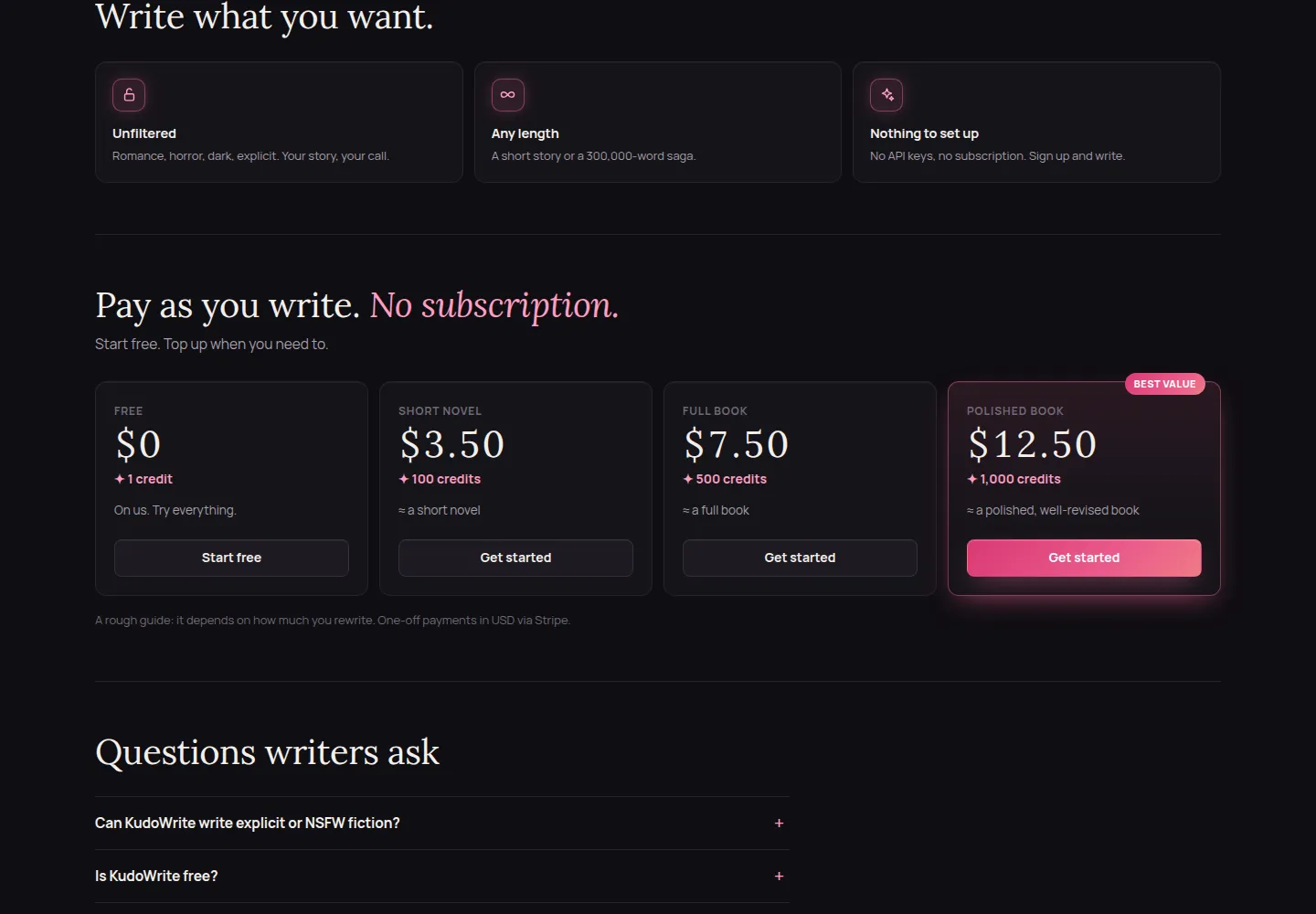
Freemium. On 2 November 2026 the home page pricing section listed one free credit after you confirm your email, then one-off packs: $3.50 for 100 credits, $7.50 for 500, and $12.50 for 1,000. No subscription. The FAQ says the free credit is about 10 simple rewrites and that no card is required to sign up. Pack size is described as a rough guide. Stripe takes the payment. You can also bring an OpenRouter or Mistral key, and the FAQ says KudoWrite adds no markup.
Checked 4 November 2026. Plans move. The vendor's page wins an argument with this one.
Good to know
At a glance
- Availability
- Country blocks: not stated. Manuscripts are stored in the EU (Ireland). You must be 18 to create an account. The pages do not name a company. Contact is admin@kudowrite.com.
- Platforms
- Website. The newsroom says any modern browser, on desktop and on mobile. Nothing to install.
- Languages
- The 31 October 2026 newsroom says 22 languages, and names English, Japanese, Arabic, and Hindi, plus more. It does not print the full list.
- Launched
- New: launched KudoAI was announced on 9 October 2026. Suggest Beat shipped on 31 October 2026. The privacy policy says an August 2026 change moved storage off the browser and onto an account. The original launch date is not stated.
- Independent reviews
- iTechGuides has a 2026 page that scores KudoWrite 3.0 out of 10 and still says you must bring an OpenRouter or Mistral key. On 2 November 2026 the vendor's pricing section listed built-in KudoAI packs from $3.50. Use the vendor page for the price.
- AI training and retention
- Privacy policy, last updated November 2026: KudoWrite does not train on the manuscript. Purchased credits go through OpenRouter to providers that do not retain prompts or train on them. The free credit uses that route until the allowance runs out, then Mistral under Mistral's terms. Prompts are not stored. Your own key follows that provider. They say they can read the database and that they do not.
New tools are checked again three months after the Checked date above.
In-depth review
KudoWrite review
Last checked 4 November 2026 against the vendor's public pages. Prices and features change; check the vendor before you buy.
Writer's Toolbelt review
KudoWrite
A beat-by-beat novel studio with a story bible and built-in KudoAI. One free credit, then prepaid packs. No subscription.
- free credit after email confirmation
- for 100 credits, once
- languages, vendor figure
Full disclosure: I also build ProseEngine, an AI fiction-writing tool listed on the same terms as everyone else.
What it is
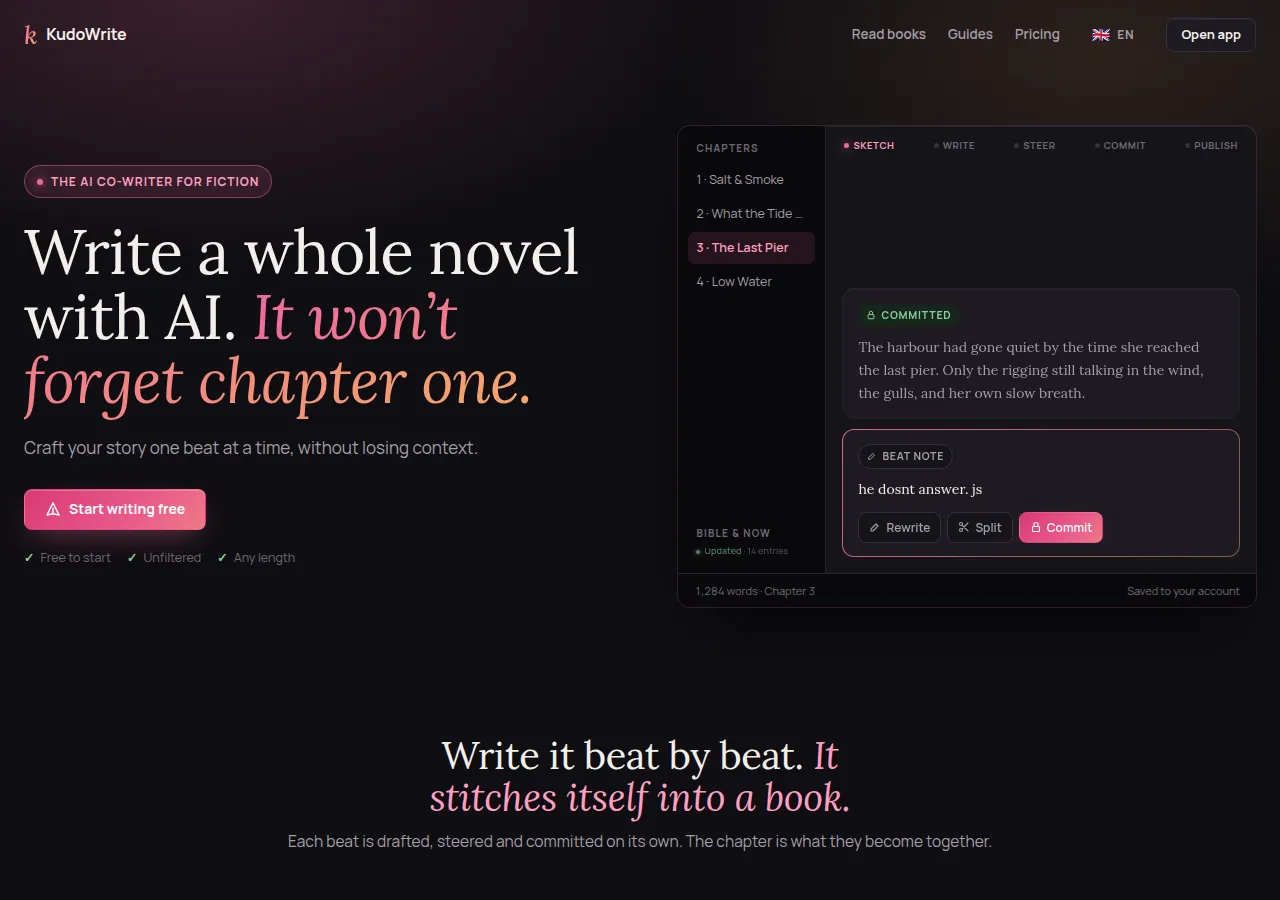
KudoWrite is a browser app for writing a novel one beat at a time. The home page's line is that the AI will not forget chapter one. You draft a beat, steer or rewrite it, and commit it. The committed beat is stitched into the chapter, and the story bible updates. The next request is supposed to see the right entries from that bible, plus a running summary of the book.
This review is what the public pages said on 2 November 2026. We did not open an account, spend a credit, or commit a beat. The sample pier, the boat called the Mara, and the names Nell and Tomas are on the vendor's pages. They are not a result from this review.
The pages do not name a company. The footer is © 2026 KudoWrite. The terms refer to "the developer of kudowrite." Contact is admin@kudowrite.com. You must be 18 to create an account. The privacy policy, last updated November 2026, says an August 2026 change moved storage off the browser. Google Drive sync, which earlier versions offered, has been removed. Writing now sits in a PostgreSQL database on Supabase in Ireland, with row-level security. The same section says an administrator of that database is technically able to read it, that they do not, and that nothing trains on it.
Who it's for
- Novelists who think in beats. The home page is built around a board of beats, not a single chat box. Commit is the step that locks a beat into the manuscript.
- Writers who want a small prepaid pack instead of a monthly plan. The pricing section lists one free credit and three one-off packs. There is no subscription.
- Writers of romance, horror, dark, or explicit fiction. The home page says KudoWrite adds no content filter of its own. The model's own behaviour still applies. Community Books, if you publish there, asks for a rating, and explicit books sit behind an 18+ notice.
It is a weak fit if you want a local file that never touches a server. That was an earlier version. It is a weak fit if you need a developmental report, a series bible that spans several books, or a shared account. None of those is described.
Key features in practice
- Beats, then a chapter. Each beat is drafted, steered, and committed on its own. The chapter is what the committed beats become. The hero illustration shows Rewrite, Split, and Commit on a beat, and a chapter count of 1,284 words. Another block on the same page shows a 99-word chapter. Both are their illustrations.
- Three gears. On 4 November 2026 the home page names them Stick, Balanced, and Novel. Stick stays close to your words. Balanced adds a little. Novel fills the beat out. The 31 October 2026 press release still says Stick, Short, and Novel for the Writing slot. The home page's version list labels one rewrite "Balanced."
- Friend chat, in the privacy policy only. The November 2026 policy says the account stores messages with friends, that only the people in a chat can see it, that deleting a message wipes the text for everyone, and that messages are used to deliver them and are never sent to an AI model. The home page and the newsroom do not describe that chat. The newsroom's newest release is still 31 October.
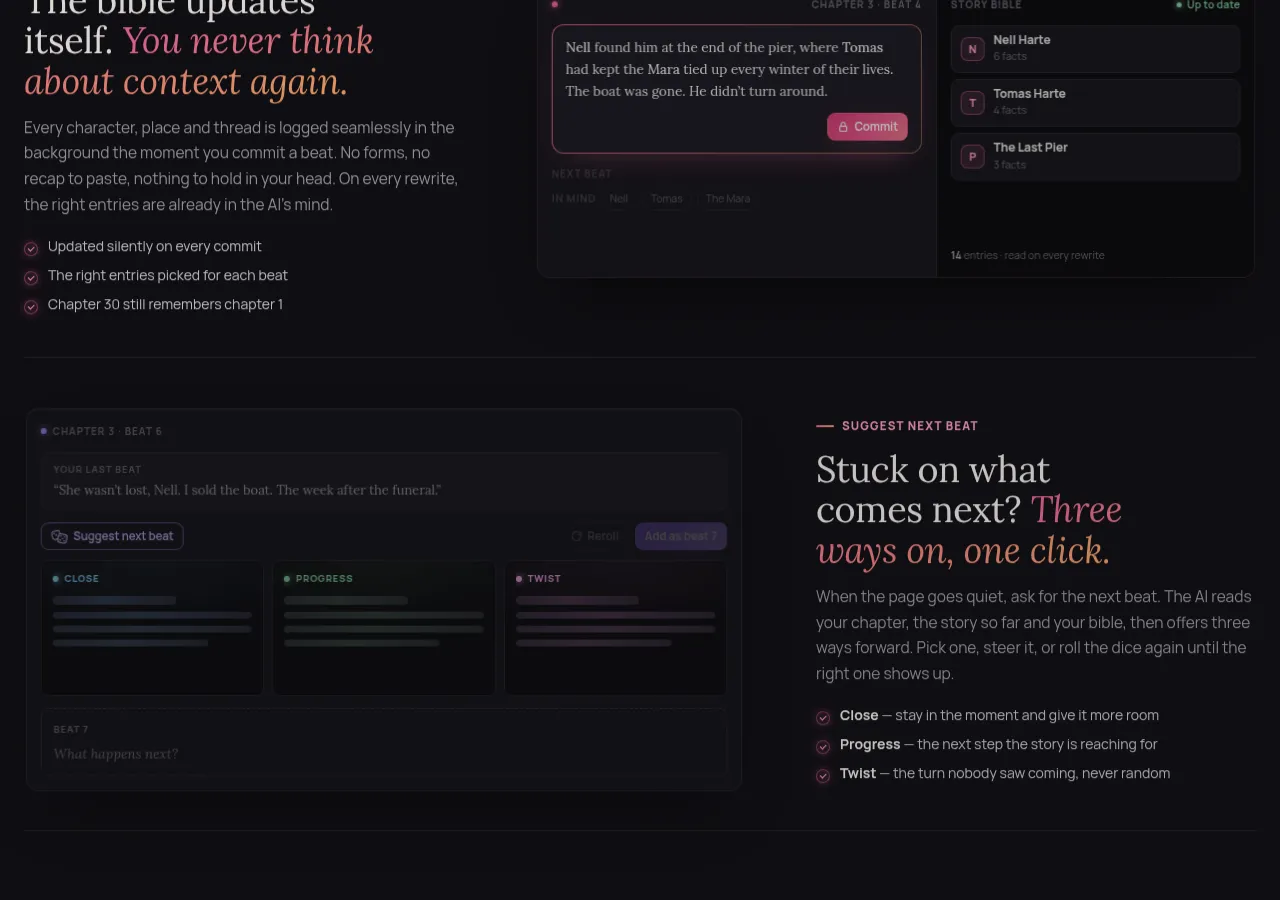
- Suggest Beat. One click offers three next beats: Close stays in the moment, Progress takes the next step, and Twist is the turn. The release says nothing is written into the manuscript until you say so. You can reroll. The sample cards on the page, about a sold boat and a riding light, are the vendor's demo.
- Two slots, same credits. The 31 October release says KudoAI now runs as two specialized slots. A Utility model picks bible entries, writes summaries, and runs Suggest Beat. A Writing model drafts the prose. The release says the credits are the same, and that the prose is better than the first KudoAI. It does not name the underlying model.
- Story bible. Characters, places, items, and events. The home page says every committed beat updates it, that the right entries are picked for the next rewrite, and that you can read and edit the bible and the summary in the sidebar. The sample shows "14 entries" and a fact count per name. Those numbers are on the marketing page.
- Versions. Rewrite, steer, undo, and branch. The page says each change is a version, that nothing you wrote is overwritten, and that you can compare two versions. The illustration includes a raw beat with typos and a cleaned rewrite. Treat the cleaned paragraph as their example of the gear, not as a measurement.
- Import. The FAQ says My Books → Import reads .docx, .odt, .epub, .html, .md, .txt, and .rtf, plus a Scrivener or Novelcrafter zip and NovelAI .story files. Story bibles can come from a Sudowrite CSV, a Novelcrafter codex, a NovelAI lorebook, and AI Dungeon story cards. Detecting chapters and scene breaks is free, the FAQ says.
- Community Books. Optional. Nothing is public until you press Publish on a chapter. Readers get a page, an EPUB, comments, and kudos. The terms also name PDF, HTML, and text downloads for personal reading. You can unpublish. The licence you grant lasts while the work is published. Readers who already downloaded a copy are not recalled.
- Your own key. Settings can hold an OpenRouter or Mistral key. The FAQ says KudoWrite adds no markup. With your own key, the privacy policy says the prompt goes from the browser to that provider and does not pass through a KudoWrite server. Whether that provider trains on it is that provider's rule.
- Length. The home page says a short story or a 300,000-word saga. It does not publish a hard cap.
Pricing (checked 2 November 2026)
The prices are on the home page, in the block labelled as a pricing section. https://kudowrite.com/pricing returned 404. The terms say the price is the one shown in the app before you pay.
| Pack | Price | What the card says |
|---|---|---|
| Free | $0 | 1 credit. "On us. Try everything." The FAQ says this is about 10 simple rewrites, after you confirm your email, with no card. |
| Short novel | $3.50 once | 100 credits. The card calls that roughly a short novel. |
| Full book | $7.50 once | 500 credits. Roughly a full book. |
| Polished book | $12.50 once | 1,000 credits. The card says a polished, well-revised book. |
The line under the cards says the counts are a rough guide and depend on how much you rewrite. Payments are one-off, in USD, via Stripe. The terms say credits cannot be transferred or exchanged for cash, and that a leftover free credit is added to the balance when you buy a pack. Each request spends credits according to the AI usage it consumes. The pages do not publish a credit-to-token table. Check the vendor if you need the rate.
Pricing at a glance
- Free1 credit after email confirmation. FAQ: about 10 simple rewrites. No card.Free
- Short novel100 credits
$3.50 once
- Full book500 credits
$7.50 once
- Polished book1,000 credits
$12.50 once
Using it as a writer
- Read the August change before you paste a book you kept offline on purpose. The privacy policy says the old version could not see your manuscript even if someone wanted to, because it lived in the browser. The current version stores it on a server they operate. They say they do not read it. They also say they are able to.
- Spend the free credit on one beat, not on a whole chapter. The FAQ's "about 10 simple rewrites" is their estimate. A Novel-gear rewrite of a long beat will not be ten of those.
- Commit only what you mean to keep in the bible. The bible updates on commit. A throwaway experiment that you commit becomes a fact the next beat can see.
- Treat Suggest Beat as three options, not a plot. The release says you pick, steer, or roll again. The demo's three cards are theirs.
- Export or copy anything you cannot lose. The terms say the app is provided as is, with no warranty against data loss. Deletion in the app is immediate and they say there is no backup to restore. You can email admin@kudowrite.com for a JSON copy of your projects.
- If you publish a chapter, assume a reader can download it. Unpublishing stops the public page. It does not pull back a file someone already saved.
Strengths
- The price is a number, on the page, and it is not a subscription. $3.50, $7.50, and $12.50. The free credit needs an email confirmation and no card.
- The training language is specific for purchased credits. OpenRouter, zero data retention, no training, and they say the prompt text is not kept after the request. The usage record keeps the credit cost, the model, the token count, and which feature it was. Not the prose.
- You are told you own the manuscript. The terms say KudoWrite claims no rights, does not sell the work, and does not make it public unless you publish a chapter.
- The bible is described as something you can edit, not only as a hidden prompt. Import from Sudowrite, Novelcrafter, and NovelAI is listed, which matters if you are leaving one of those.
- Suggest Beat is dated. The 31 October 2026 release says what the three cards are and that the credits did not change when the two slots arrived.
Writer's Toolbelt editorial scores
KudoWrite scorecard
7.0/10
- Beat drafting8/10
- Story bible8/10
- Price clarity7/10
- Privacy terms7/10
- A subscription-shaped studio5/10
Weaknesses
- The free path is not the paid path. While KudoWrite's free allowance lasts, the free credit uses the same OpenRouter route. When that allowance runs out, the privacy policy says the free credit runs on Mistral under Mistral's terms. Purchased credits are used first once you have bought any, so they stay on the no-training route. If you never buy, you are on the fallback the policy hands to Mistral.
- They can read the database. The privacy policy says this plainly, and says they will not. That is a promise, not the old technical inability.
- "A full book" is a rough guide. Five hundred credits is not a contract for a finished novel. Heavy Novel-gear rewrites will spend the pack faster. There is no published rate.
- No company name on the pages we read. You are contracting with "the developer of kudowrite," by email.
- An outside page is behind the product. iTechGuides scores KudoWrite 3.0 out of 10 and still says you must bring an OpenRouter or Mistral key, with provider charges billed separately. The vendor's pricing section on 2 November 2026 listed built-in packs from $3.50 and an optional key. Use the vendor page for the price.
- Community Books is a public library if you press Publish. Comments, kudos, and downloads are part of that. It is easy to describe and easy to turn on by mistake if you are clicking through a finished chapter.
- No local model. Your own key is OpenRouter or Mistral, in the cloud.
How it compares
- KudoWrite vs Sudowrite. Sudowrite is a monthly credit studio with a Story Bible, continuation, and rewrite tools inside one subscription. KudoWrite is beats, a bible that updates on commit, and a pack you buy once. If you already live in Sudowrite, the import FAQ is the page to read before you move a manuscript. See the Sudowrite review.
- KudoWrite vs Novelcrafter. Novelcrafter's codex is yours to maintain, and from Hobbyist up you bring your own key, including a local model. KudoWrite will take an OpenRouter or Mistral key, and it also sells the model inside the credit. A local model is not described. See the Novelcrafter review.
- KudoWrite vs AuthorFlows. AuthorFlows is $10 a month or $96 a year for an editor, eight structures, and a Story Analyzer, with no free studio plan. KudoWrite is a credit pack and a beat board. The Analyzer is a report you run. Suggest Beat is three next beats. See the AuthorFlows review.
- KudoWrite vs ProseEngine. ProseEngine is made by the person who runs this site. See the disclosure above. It is a fiction studio with a codex and scene generation, priced in euros, with a free plan. We are not scoring that matchup.
Feature comparison
Fiction workspaces at a glance
| Feature | Sudowrite | Novelcrafter | Loreon | LivingWriter | Unsloppy | Prosematter | Creader | AuthorFlows | Prospero | KudoWrite | Novela Studio | Writers Studio | Musael |
|---|---|---|---|---|---|---|---|---|---|---|---|---|---|
| AI models included in the price | Yes30+ models plus Muse & Ballad | NoBring your own key | YesCredits pay for Anthropic API runs | YesIncluded; capped except on Pro + AI | YesHosted catalog; spent as Ink | YesCredits call the vendor's API providers | YesToken allowance on each plan | YesIncluded; routed through OpenRouter. Daily request cap: number not stated | YesFree open models included. Paid plans add stronger models. Daily caps | YesKudoAI credits included. Your own OpenRouter or Mistral key is optional | NoYour own Anthropic, OpenAI, Google, or OpenRouter key. Write-it-myself sends nothing. | PartlyDirect is bring-your-own-key. The App Store edition sells optional hosted AI. Ollama is local and does not use that allowance. | PartlyInk and Press include monthly credits routed through OpenRouter. Quill includes none. Extra credits are a separate purchase. |
| Bring your own API key | Not listed | YesHobbyist and up | Not listed | Not listed | Not listedPublic pages describe a hosted catalog | Not listedVendor names its own providers | PartlyDesktop bundle strings name DeepSeek, Kimi, or GLM keys in ai.env. The download page says local use needs no key. We did not install it. | NoNo bring-your-own-key on the public pages | NoNo bring-your-own-key on the public pages | YesOpenRouter or Mistral, from Settings. The FAQ says no markup | YesRequired only if you turn AI help on. | YesDirect edition, for OpenAI, Anthropic, or Gemini. The App Store edition uses a cloud proxy and does not ask for a key. | NoMusael's own checks do not ask for an API key. On Press, an MCP client such as Claude Code uses that client's own subscription. |
| Local models | Not listed | YesLocal AI support | Not listed | Not listed | Not listed | Not listed | NoDesktop page says Guardian's local rules run on the computer. A local model is not described. | NoNo local model on the public pages | NoNo local model on the public pages | Not listedNot described | Not listedNot described. | YesOllama on the Mac, and a self-hosted OpenAI-compatible server. | Not listedA local writing model is not described. Quill sends nothing to a model. Dictation can say On device, which is the browser's speech recognition. |
| Story bible / codex | YesStory Bible | YesCodex with progressions and relations | YesStructured canon the prose is checked against | PartlyElements board: people, places, objects | YesStory Canon; you approve each note | YesCodex for characters, places, objects | YesCharacters, places, timeline, and typed relationships, extracted from the prose | YesCharacter profiles, story map, timeline, and a Story Bible named on the pricing card | PartlyPrep phases: premise, characters, world, voice, outline. Not a queryable codex | YesUpdates when you commit a beat: characters, places, items, events | YesStory World: people, knowledge, places, objects, timeline, secrets. | YesEight entity types: characters, locations, items, events, organizations, races, magic, and lore. | YesCodex of characters, places, objects, and events, with relations and a timeline. Maps with pins are Ink and Press. |
| Series continuity | YesAll plans | YesShared codex across a series | YesCross-volume checks; one bible for a series | Not listedAppears-in tracking is per manuscript | PartlyPremium is pitched for a series; cross-book checks: check vendor site | YesHome page: book six keeps book-one decisions | Not listedDraft-against-canon checks; a cross-book series check is not in the sources we used | PartlyUnlimited stories, each with its own profile. No cross-book checker described | PartlyA continuity check is in the book tools. Studio advertises the strongest checker for it. A cross-book series check is not described | PartlyThe FAQ says chapter 30 is written with chapter 1. A cross-book series check is not described | Not listedThe page says chapter 23 stays true to chapter 2. A cross-book series check is not described. | PartlySeries can group manuscripts. Continuity checks are described across chapters. A cross-book series check is not described. | PartlyInk and Press can put several books in one project that shares a World. AI continuity is described across chapters. A single pass over every book in a series is not spelled out. |
| Editable prompts with preview | PartlyVia plugins | YesCustom prompts and prompt preview | Not listed | Not listed | Not listed | PartlyReusable custom prompts; preview: check vendor site | Not listed | Not listed | PartlyYou can type your own refine instruction. A prompt library with preview is not described | PartlyYou can steer a beat and type a note. A prompt library with preview is not described | Not listedThree help levels per book. A prompt library with preview is not described. | Not listedA prompt library with preview is not described. | Not listedA prompt library with preview is not described. Musy shows the text, the answer language, and the credit price before a task is sent. |
| Editorial feedback tools | YesDev edits, line edits, beta reads (Professional+) | PartlyWorkshop chat; advanced review marked planned | YesFindings cite passages; not a copyedit | PartlyAI Analysis on paid plans | PartlyHumanizer and proposal review; not a dev edit | YesNamed AI editors on the draft | YesGuardian: continuity, prose, scene, suspense, and plot | YesStory Analyzer. The sample notes on the page are the vendor's illustration | PartlyAI-habit checker and refine buttons. Not a developmental edit | PartlySuggest Beat offers three next beats. A manuscript report is not described | PartlyScorecards for tired phrases. A plot audit is named. We did not run it. | PartlyA continuity checker for contradictions and timeline issues. A line edit or developmental report is not described. | YesInk and Press list scene review, a style pass, continuity across chapters, and a manuscript analysis. Quill has rule-based checks only. This review did not run them. |
| Plan without AI | No | YesScribe, $4/mo or $40/year | YesEditor is free; credits only for agent runs | NoEvery plan includes an AI allowance | NoFree still includes 36 Ink a day | YesEditor, imports, and exports are free | PartlyBrowser Free includes Guardian and 100K tokens. The desktop page says local writing and local Guardian rules need no AI key. | NoOne paid plan. A toggle can turn generation off. The price stays the same | YesFree plan, and a mode where you write every word. AI runs when you ask | PartlyYou type the raw beat. A separate no-AI price is not listed | YesWrite it myself includes templates, tracking, scorecards, and exports. | YesThe FAQ says the editor, worldbuilding, and export work without AI. Direct is $59 once. The App Store editor is free. | YesQuill is the writing and planning plan and sends nothing to a model. On 8 November 2026 it was $18.98 a month, or $15.98 a month billed yearly. |
| Team collaboration | Not listed | YesSpecialist plan | Not listed | YesComments and sharing; Free caps at 2 | Not listedTerms: stories stay private to the account | YesCo-writer cursors and margin comments | Not listed | NoTerms: accounts are for one person | PartlyBeta readers and messages. Studio is pitched for groups and classes. Shared editing is not described | NoShared editing is not described. Community Books is optional publishing | NoOne license, one person. | Not listedFamily Sharing is on the App Store card. Shared editing is not described. | YesEvery plan can invite an editor, commenter, or viewer. People who share the plan and its credits: 1 on Quill, up to 2 on Ink, up to 5 on Press. |
| Free trial, no card | YesTrial length not stated | Yes21 days | PartlyFree editor; welcome credits (amount: check vendor site) | Yes7 days on Pro and Pro + AI | YesFree tier, no card | Partly500 welcome credits; card requirement: check vendor site | YesFree plan, no card | NoNo free studio plan. A structure checker on the home page needs no account. Eight-day refund on a first payment | YesFree plan. Google sign-in. No card | Yes1 credit after email confirmation. The FAQ says about 10 simple rewrites. No card | No$148 once. No free plan on the product page. | YesDirect: 7 days, no account and no card, one Mac. App Store hosted-AI trials are on the listing; a card requirement for those: check the App Store. | NoNo free trial of your own book. A guided demo uses a sample story and does not start a subscription. Free browser tools need no account. |
Verdict
KudoWrite is a real novel studio with a public price: one free credit, then $3.50, $7.50, or $12.50, and no subscription. The 31 October 2026 release adds Suggest Beat and splits KudoAI into a bible slot and a prose slot without changing that price. The privacy page is clearer than most about training, and it is also clear that the server can see the manuscript and that the free credit can leave the no-training route.
Pay for a pack if the beat board is the shape you want and the rough credit guide is enough. Do not pay because a directory still says the app is free if you bring a key. That description is older than the pricing section.
Noted on 4 November 2026
The packs were unchanged: one free credit, then $3.50, $7.50, and $12.50. The newsroom still ends at the 31 October releases. Two things on the public pages moved. The home page now calls the middle rewrite gear Balanced. The 31 October release still calls it Short. The privacy policy's last-updated line now reads November 2026. The training route is the same sentence as before: no training on their side, purchased credits through OpenRouter with no retention, the free credit falling through to Mistral when the allowance runs out. The new policy text also describes friend chats that never go to a model. The home page does not.
FAQ
Is KudoWrite free? You get one credit after you confirm your email. The FAQ says that is about 10 simple rewrites, and that no card is required. After that the packs are $3.50, $7.50, and $12.50.
How much does it cost? Those three packs, once, in USD, via Stripe. There is no subscription. The page says the credit counts are a rough guide.
Does KudoWrite train on my novel? The privacy policy says no, not on their side, and that purchased credits go only to providers that do not retain prompts and do not train on them. The free credit uses that route until KudoWrite's free allowance runs out, then Mistral under Mistral's terms. A key of your own is governed by that provider.
Do I own what I write? The terms say you own everything you write. Publishing a chapter on Community Books gives them a licence to host and let readers download it while it stays published. You can unpublish.
Does it remember chapter one? The FAQ says every committed beat updates the story bible and a summary of the whole book, and that chapter 30 is written with chapter 1 in context. That is their description. This review did not run it.
Free guide
The 10 best free AI tools for writers
Join the Writer's Toolbelt newsletter for a short note when the shelves change, and get the free PDF guide.
Nearby on the shelf
Write fiction
Book generators
Amavie
A book on Amavie is a manuscript you can also read as pages, with a cover, a blurb, and an AI co-author that plans for free and, on a paid plan, can write whole chapters. Handwritten text is not overwritten by a rebuild. The same account is a character chat, and the terms license your content for operating and promoting the service until you delete it.
Best for Writers who want to publish a serial chapter by chapter beside a cast of AI characters, and who will read the license before they upload a manuscript they mean to sell elsewhere.
FreemiumFictionWrite fiction
Novel studios
AuthorFlows
A browser studio for novels: an outline generator, a paginated editor, character cards, a story map, a timeline, a Story Bible, and a Story Analyzer you run on purpose. The home page also has a structure checker you can use with no account. The studio itself is still paid. The home page says the manuscript is never used to train a model, and that you can turn generation off. The privacy policy and terms on the site say they take effect on 16 November 2026.
Best for Fiction writers who want outline, cast, and a chapter editor in one browser tab, and who will pay before they can try a manuscript.
SubscriptionFictionWrite fiction
Novel studios
Creader
An editor for long fiction that extracts a world memory from the prose and checks the draft with Guardian. On 3 November 2026 the how-it-works page said quick rule checks run while you pause, and that deeper checks wait until you press Run. Drafting still waits until you ask. A desktop download, version 1.28.0 dated 24 October 2026, says the manuscript can stay on the computer. A 21 October browser snapshot on 230 words caught one of six planted contradictions and quoted only the word "eyes". The founder says Guardian is being rebuilt.
Best for Fiction writers who want the manuscript and an extracted canon in one browser project, and who will test the continuity check on a chapter they already understand.
FreemiumFiction