Getting words down
Creader
A browser editor for long fiction that extracts a world memory from the prose and checks the draft with Guardian, across continuity, prose, scene, suspense, and plot. Drafting runs only when you ask. On a 230-word Free-plan sample the checker flagged one of six planted contradictions and quoted only the word "eyes"; the product is new, and its founder says Guardian is being rebuilt.
Best for
Fiction writers who want the manuscript and an extracted canon in one browser project, and who will test the continuity check on a chapter they already understand.
Pricing
Freemium. Free is $0: unlimited projects, 50 entities per project, 100K tokens a month, Guardian on all five layers, 3 book imports lifetime, publishing with Creader branding, and the MCP API. Checked 21 October 2026: Pro $9.99/month or $99.99/year (500K tokens, unlimited entities, world rules and boards, a two-model Guardian second reader, 5 imports a month, translation of 200K characters a month, no branding); Creator $29.99/month or $299.99/year (2M tokens, a style reference library, unlimited imports, translation of 1M characters a month, 10% off token packs, priority support). Token packs never expire: $4.99/200K, $19.99/500K, $49.99/1.5M, $129.99/5M. USD only. The pricing page has no VAT note.
Listing checked 21 October 2026. Plans move. The vendor's page wins an argument with this one.
In-depth review
Creader review
Last checked 21 October 2026 against the vendor's public pages. Prices and features change; check the vendor before you buy.
Disclosure: The person who runs Writer's Toolbelt also makes ProseEngine, an AI fiction-writing app that competes with Creader. This review sticks to verifiable facts and links its sources below.
Writer's Toolbelt review
Creader
A long-form editor that extracts a world memory and runs Guardian against the draft. Free to start. The checker is young.
- Free plan, no card
- Pro per month
- Guardian layers on every plan, including Free
What it is
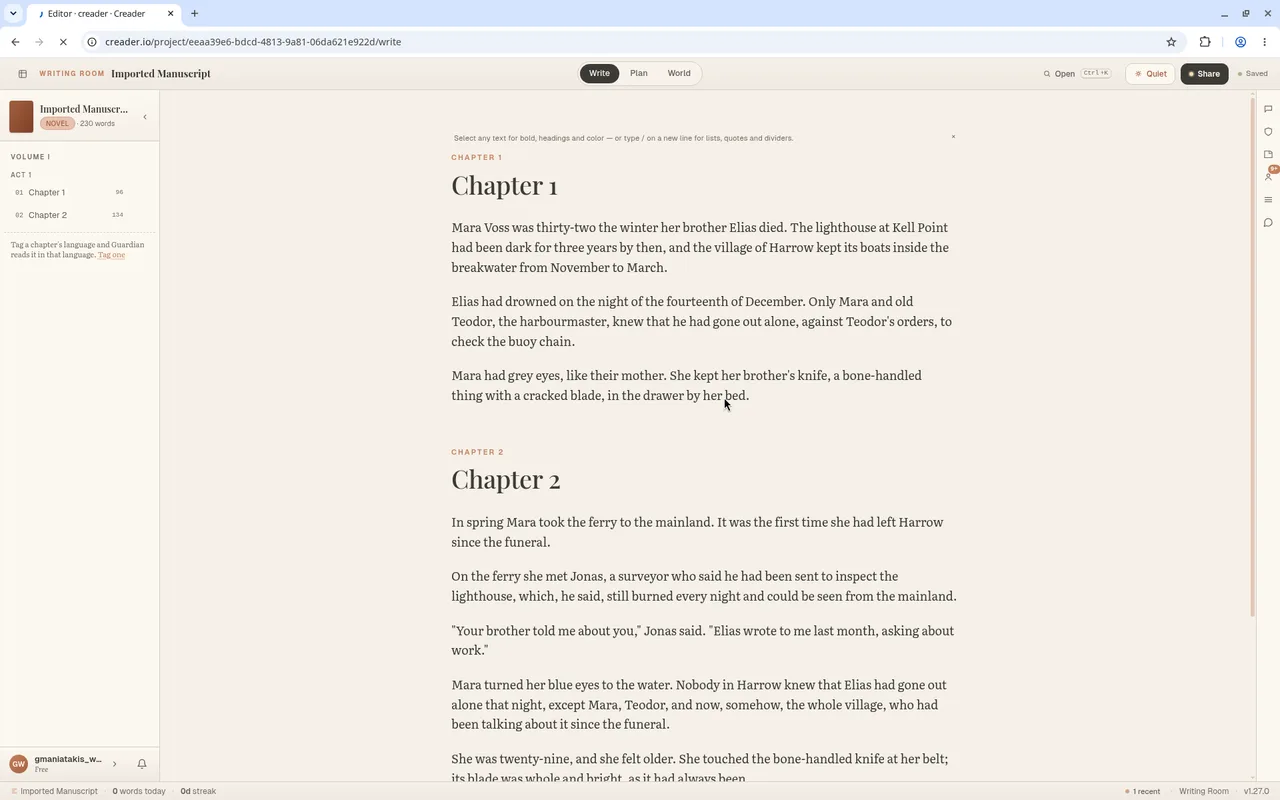
Creader is a browser editor for long fiction. You write, or you import a manuscript, and the app keeps a structured world memory beside the prose: characters, places, a timeline, and typed relationships, extracted from the draft. The check is called Guardian. The home page says it reads the draft against canon across five layers — continuity, prose, scene, suspense, and plot — and that each flag comes with the evidence behind it and a one-click suggested fix.
The verification page states the standard in one sentence: "Every flag quotes the established fact and the contradicting line." The how-it-works page says drafting is separate from that. You press / when you want a hand. Generation is not the idle state.
The site names Tim Shen, in London, as the founder, and says he wrote fiction for a decade. The pages we used print "© 2026 Creader" and do not name a legal entity. The domain was registered on 1 January 2026 (RDAP). A Product Hunt launch is dated 18 June 2026. We found no independent reviews. On 24 September 2026 Shen wrote that after v0.6.0 many detectors were defective or unusable, and that Guardian is being rebuilt.
Who it's for
- Novelists in revision who already have prose and are afraid a later chapter has quietly broken an earlier fact: an age, a death, a secret, an object.
- Writers who want the canon extracted, rather than typed into a wiki by hand, and who will still read the cards before they trust them.
- Writers who want the model quiet until they ask. The checking side is the product. Drafting is a keystroke.
It is a weak fit if you want a local model, a bring-your-own-key setup today, or a line editor you already trust on a book-length file. It is also a weak fit if you need the checker to be finished. The founder says it is not.
Key features in practice
- World memory. Characters, places, a timeline, and typed relationships, pulled from the prose. On the Free plan a project holds 50 entities. Pro and Creator lift that cap. "Facts your chapters established" — dated facts — are marked Pro only. We did not open that view.
- Guardian. Five layers, on every plan including Free: continuity, prose, scene, suspense, and plot. The how-Guardian-works page (20 July 2026) says deterministic checks run first — kinship and age, containment, residence, status, timeline — and model checks run after that, on passages the app retrieves. The home page promises the evidence and a one-click suggested fix. Hold any flag to the verification page's sentence, not to the layer name.
- A second reader, on Pro. Two models cross-check. We did not run it. Anything this review says about hit rate is the Free-plan Guardian only.
- Drafting only when you invoke it. Press
/. We did not ask for prose, and this review does not score a paragraph we never saw. - Import limits. Free includes three book imports over the life of the account. Pro includes five a month. Creator includes unlimited imports. Our import used one of the three.
- Also on the public pages, and not in our test: translation (200K characters a month on Pro, 1M on Creator), publishing (Creader branding on Free, none on paid plans), world rules and boards on Pro, a style reference library on Creator, and an MCP API, which is included on Free. No local models. Bring-your-own-key is described as on the roadmap.
- Privacy. The privacy policy is effective 15 April 2026. Text goes to the model in use. The policy says the OpenAI, Anthropic, and Google APIs are not used for training. It says DeepSeek V3 may be used for model improvement, and MiniMax follows that provider's terms. Privacy Mode restricts requests to OpenAI, Anthropic, and Google. In the account we opened, Privacy Mode was on by default, under Settings, AI & Models, Data privacy. That was one account. Confirm the toggle on yours before you paste a book. Separately, Creader may review AI interaction logs — your prompt, the AI output, and any edits you made — to improve AI quality, and may keep those logs for up to 12 months. Hosting named in the policy is in the US, on Vercel and Supabase. Account deletion takes 30 days. The terms say you own your content. They also set Delaware law and AAA arbitration.
Pricing (checked 21 October 2026)
Prices below are from the pricing page and Terms 6.1. USD only. The page does not mention VAT.
| Plan | Price | Allowance |
|---|---|---|
| Free | $0 | Unlimited projects, 50 entities per project, 100K tokens a month, Guardian on all five layers, 3 book imports lifetime, publishing with Creader branding, MCP API |
| Pro | $9.99/month or $99.99/year | 500K tokens a month, unlimited entities, world rules and boards, Guardian second reader (two models cross-check), 5 imports a month, translation of 200K characters a month, no branding |
| Creator | $29.99/month or $299.99/year | 2M tokens a month, a style reference library, unlimited imports, translation of 1M characters a month, 10% off token packs, priority support |
Pricing at a glance
- Free100K tokens/mo, 50 entities, GuardianFree
- Pro$99.99/year; 500K tokens; second reader$9.99/mo
- Creator$299.99/year; 2M tokens; style library$29.99/mo
Token packs never expire. The pricing page lists four, with no separate names:
| Price | Tokens |
|---|---|
| $4.99 | 200K |
| $19.99 | 500K |
| $49.99 | 1.5M |
| $129.99 | 5M |
The refund page says a first payment is fully refundable within 7 days, an annual plan is prorated within 30 days, and unused token packs are refundable within 14 days.
There is no published tier that drops the token allowance. Free still includes Guardian and 100K tokens a month. You can write without pressing /. On the how-Guardian-works page, the check runs deterministic passes first and then model checks on retrieved passages.
Our test
This is a snapshot from 21 October 2026. It is not a verdict on Guardian, and it is not a test of a novel.
We used the Free plan only. Signup was email and a password. No card, no captcha, then an email verification link. The account was on the Free plan. After the session the token meter read "5K of 100K".
We imported a 230-word, two-chapter sample through "Import what you have", with AI analysis. Chapters came from the headings.
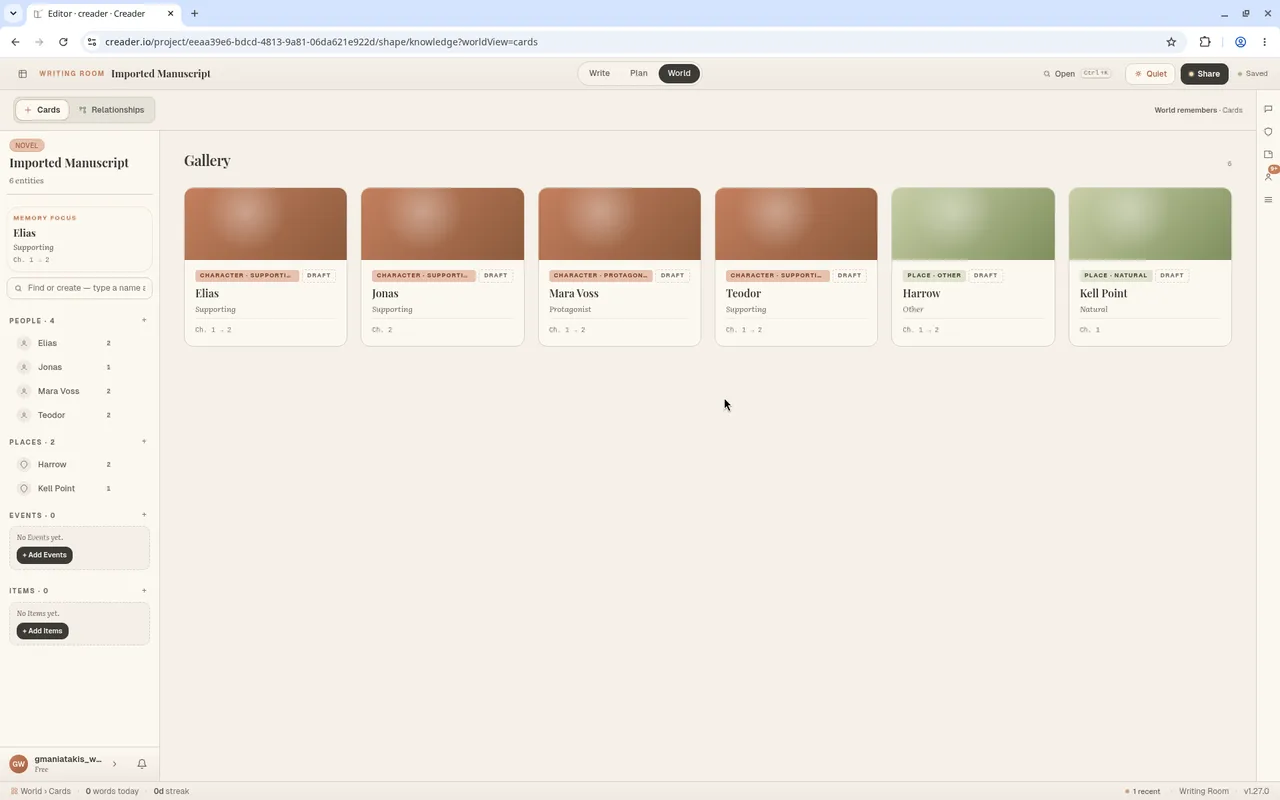
The world memory extracted four people — Mara Voss, labeled protagonist, plus Elias, Jonas, and Teodor — and two places, Harrow and Kell Point. It suggested six relationships. All six were correct. Dated facts stayed behind the Pro label. We did not see them.
The sample contained six contradictions we had planted:
- The lighthouse at Kell Point was dark, and later it was still burning.
- A brother who had died had "wrote last month."
- Eye colour was grey, and later blue.
- Age was 32, and later 29.
- A secret known to two people was, later, known to the whole village.
- A knife was cracked and in a drawer, and later whole and at a belt.
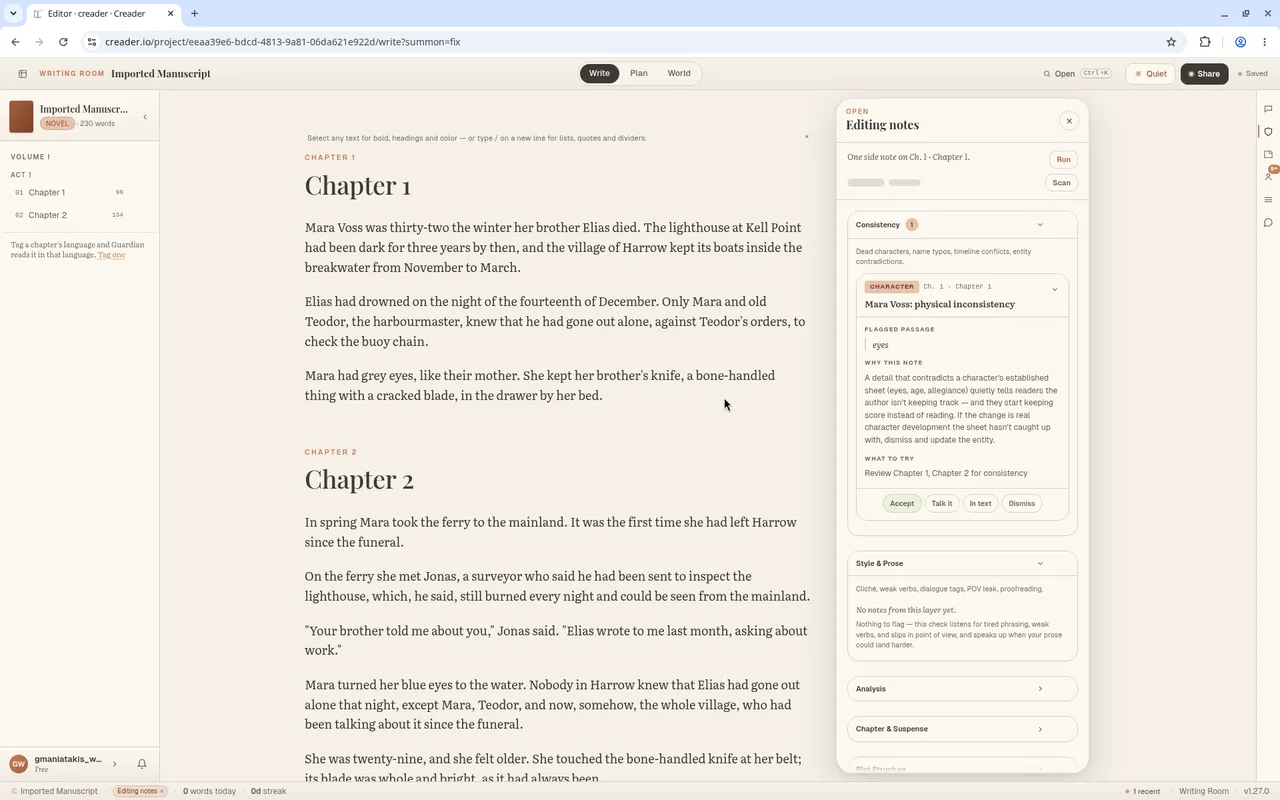
Guardian, opened from Editing notes and run with Run, raised one flag: "Mara Voss: physical inconsistency," for the eye colour. The flagged passage was the single word "eyes", with a generic explanation. It did not quote the grey line and the blue line. The other five contradictions were not flagged. The embedding Scan said "No conflicts found." There were no false flags. The analysis panel tagged the lighthouse as a motif and the knife as Chekhov's gun. Those tags are not continuity findings, and we did not count them as flags.
The first run stalled for about three minutes on "Reading the whole book…". After a reload, the result settled. A re-run took about 10 to 15 seconds. Product-tour overlays blocked clicks twice.
The Pro "second reader" was not part of this run. Dated facts were not part of it. The sample is 230 words, in two chapters, on a product whose founder says the detectors are being rebuilt, about ten months after the domain was registered.
The scores further down are the same kind of editorial marks this directory gives every other tool, applied to that snapshot. A longer manuscript, or the second reader, could land somewhere else. We did not measure either one.
Using it as a writer
- Open the free plan on a chapter you can already grade. Email and a password were enough for us. Put in a passage that contains a mistake you can name. A clean bill of health on a chapter you do not remember is not information.
- Check Privacy Mode before the manuscript is unpublished work. Ours was on by default. Yours might not be. With it off, the privacy policy says DeepSeek V3 may be used for model improvement. Logs of the prompt, the output, and your edits may be reviewed and kept for up to 12 months either way.
- Read the cards before you trust the check. On our sample the people, the places, and the six relationships were right. That is the part that worked. Dated facts were not included. If a card is wrong, a check against that card is a check against the wrong canon.
- Read the quoted passage, not the title of the flag. The verification page says a flag quotes the established fact and the contradicting line. The flag we received quoted the word "eyes". If that is all you get, you do not yet have the feature the page describes.
- Do not treat one Scan line as a sweep of the book. Our Scan said no conflicts while five planted contradictions were still in the text. Run it again if the first pass sits on "Reading the whole book…" and then decide from the quotes.
Strengths
- The free plan includes the checker. All five Guardian layers, unlimited projects, and no card. You can see the shape of a flag before you pay $9.99.
- Extraction, on this sample, was accurate. Four people, two places, six relationships, all correct, from 230 words. That is a small success and a real one.
- No false flags in the run we did. The misses were misses. The app did not invent a seventh contradiction.
- Drafting stays behind a keystroke. Press
/when you want a sentence. The editor does not have to be a generator. - The prices are printed, including annual totals, token packs, and a refund window. You do not have to guess the Pro number.
- The founder has said the detectors were defective. That is a better public sentence than a landing page that pretends the check is finished.
Writer's Toolbelt editorial scores
Creader scorecard
5.8/10
- World memory7/10
- Continuity checking5/10
- Ease of setup6/10
- Prose generation5/10
- Value for a revision pass6/10
Weaknesses
- The one flag did not meet the product's own evidence standard. "Every flag quotes the established fact and the contradicting line." Ours quoted "eyes" and explained the idea of a physical inconsistency. Five other planted breaks were silent. An embedding Scan reported no conflicts on the same text.
- The sample was tiny, and the paid check is untested. 230 words, Free plan, no second reader, no dated facts. Do not generalize this hit rate to a novel. Do not ignore it either. It is the only hands-on number we have.
- Guardian is in the middle of a rebuild. Shen's 24 September 2026 post says many detectors were defective or unusable after v0.6.0. A continuity tool that its author is replacing is not a tool to trust with the only copy of a book.
- DeepSeek may train on the text unless Privacy Mode is on, and Privacy Mode is a setting, not a promise we can make about every account. Interaction logs may be reviewed and kept for 12 months. Read the privacy policy before an unpublished manuscript goes up.
- No local model, and no bring-your-own-key yet. BYOK is on the roadmap. Today the draft goes to Creader's providers.
- The product is new, and nobody independent has reviewed it. Domain registered 1 January 2026. Product Hunt launch 18 June 2026. No legal entity on the pages. No independent reviews found on 21 October 2026.
- Web only, from what we used. The project lives in the browser. We did not test an export format, and this review will not invent one.
How it compares
- Creader vs Loreon. Loreon is the nearer tool: a manuscript editor, a structured canon, and a check you invoke, with the editor free and the agent runs on prepaid credits. Loreon's pages say a finding quotes the passage. Creader's verification page says the same thing, and the world memory is extracted rather than only maintained by hand. On our sample the flag did not quote both lines. We did not run that sample in Loreon, so this is not a head-to-head score. See the Loreon review.
- Creader vs Novelcrafter. Novelcrafter's codex is a database you maintain, and from the Hobbyist plan up you bring your own key, including a local model. Creader extracts the cards and includes a token allowance, and it does not offer a local model. Bring-your-own-key is on Creader's roadmap, not in the app we used. See the Novelcrafter review.
- Creader vs Sudowrite. Sudowrite is a prose studio: continuation, description, rewrite, and a story bible, billed as a monthly credit subscription with the models included. Creader will draft if you press
/. The thing the pages are selling is the check against the extracted canon. If the blank page is the problem, Sudowrite is the closer tool. If a later chapter has broken an earlier fact, that is the job Creader is claiming. See the Sudowrite review. - Creader vs ProseEngine. ProseEngine is made by the person who runs this site. See the disclosure above. We are not scoring that matchup.
Feature comparison
Fiction workspaces at a glance
| Feature | Sudowrite | Novelcrafter | Loreon | LivingWriter | Unsloppy | Prosematter | Creader |
|---|---|---|---|---|---|---|---|
| AI models included in the price | Yes30+ models plus Muse & Ballad | NoBring your own key | YesCredits pay for Anthropic API runs | YesIncluded; capped except on Pro + AI | YesHosted catalog; spent as Ink | YesCredits call the vendor's API providers | YesToken allowance on each plan |
| Bring your own API key | Not listed | YesHobbyist and up | Not listed | Not listed | Not listedPublic pages describe a hosted catalog | Not listedVendor names its own providers | NoOn the roadmap, not offered |
| Local models | Not listed | YesLocal AI support | Not listed | Not listed | Not listed | Not listed | NoNo local models |
| Story bible / codex | YesStory Bible | YesCodex with progressions and relations | YesStructured canon the prose is checked against | PartlyElements board: people, places, objects | YesStory Canon; you approve each note | YesCodex for characters, places, objects | YesCharacters, places, timeline, and typed relationships, extracted from the prose |
| Series continuity | YesAll plans | YesShared codex across a series | YesCross-volume checks; one bible for a series | Not listedAppears-in tracking is per manuscript | PartlyPremium is pitched for a series; cross-book checks: check vendor site | YesHome page: book six keeps book-one decisions | Not listedDraft-against-canon checks; a cross-book series check is not in the sources we used |
| Editable prompts with preview | PartlyVia plugins | YesCustom prompts and prompt preview | Not listed | Not listed | Not listed | PartlyReusable custom prompts; preview: check vendor site | Not listed |
| Editorial feedback tools | YesDev edits, line edits, beta reads (Professional+) | PartlyWorkshop chat; advanced review marked planned | YesFindings cite passages; not a copyedit | PartlyAI Analysis on paid plans | PartlyHumanizer and proposal review; not a dev edit | YesNamed AI editors on the draft | YesGuardian: continuity, prose, scene, suspense, and plot |
| Plan without AI | No | YesScribe, $4/mo or $40/year | YesEditor is free; credits only for agent runs | NoEvery plan includes an AI allowance | NoFree still includes 36 Ink a day | YesEditor, imports, and exports are free | NoFree includes Guardian and 100K tokens a month |
| Team collaboration | Not listed | YesSpecialist plan | Not listed | YesComments and sharing; Free caps at 2 | Not listedTerms: stories stay private to the account | YesCo-writer cursors and margin comments | Not listed |
| Free trial, no card | YesTrial length not stated | Yes21 days | PartlyFree editor; welcome credits (amount: check vendor site) | Yes7 days on Pro and Pro + AI | YesFree tier, no card | Partly500 welcome credits; card requirement: check vendor site | YesFree plan, no card |
Verdict
This is a snapshot of 21 October 2026: the public pages, plus one Free-plan afternoon on 230 words. It is not a grade of the Guardian the founder says is being rebuilt, and it says nothing about the Pro second reader or about dated facts.
On that snapshot, Creader is a real writing room with an extracted canon and a checker included before you pay. The cards on our sample were right. The checker caught one eye-colour break, raised no false flags, missed the other five, and did not quote the two lines its own verification page requires.
Use the free plan on a chapter that already contains a mistake you can point at. If the flag quotes both lines, Pro at $9.99 is a cheap way to see whether the second reader does more. If the flag quotes a single word, do not buy the year because the home page promised evidence. The credits and the subscription can wait until the quote is there. Guardian, by its author's account, is still being rebuilt.
FAQ
Is Creader free? Yes. Free is $0: unlimited projects, 50 entities per project, 100K tokens a month, Guardian on all five layers, three book imports over the life of the account, publishing with Creader branding, and the MCP API. Our signup on 21 October 2026 asked for an email and a password, not a card.
How much is Pro? On 21 October 2026, Pro was $9.99 a month or $99.99 a year: 500K tokens a month, unlimited entities, world rules and boards, a Guardian second reader that cross-checks with two models, five imports a month, translation of 200K characters a month, and publishing without Creader branding. Creator was $29.99 a month or $299.99 a year. Token packs, which do not expire, were $4.99 for 200K, $19.99 for 500K, $49.99 for 1.5M, and $129.99 for 5M. USD only. The pricing page does not mention VAT.
Does Creader train on my manuscript? The privacy policy, effective 15 April 2026, says text is sent to the model you are using. It says the OpenAI, Anthropic, and Google APIs are not used for training, that DeepSeek V3 may be used for model improvement, and that MiniMax follows that provider's terms. Privacy Mode limits requests to OpenAI, Anthropic, and Google. In the account we opened it was on by default, under Settings, AI & Models, Data privacy. Confirm the toggle on yours. Creader may also review AI interaction logs — your prompt, the AI output, and edits you made — to improve AI quality, and may keep those logs for up to 12 months.
Will Guardian catch contradictions? Not as a rule, on the only run we did. A 230-word, two-chapter sample on the Free plan had six planted contradictions. Guardian raised one flag, for eye colour, and the quoted passage was the word "eyes". The other five were not flagged. An embedding Scan reported no conflicts. There were no false flags. The sample was tiny, the Pro second reader was not run, and on 24 September 2026 the founder wrote that many detectors were defective or unusable and that Guardian is being rebuilt. Treat the run as a snapshot.
How new is Creader, and who makes it? The site names Tim Shen, in London, as the founder. The pages we used print "© 2026 Creader" and do not name a legal entity. The domain was registered on 1 January 2026. A Product Hunt launch is dated 18 June 2026. We found no independent reviews on 21 October 2026.
Do I own what I write there? The terms say you own your content. They also set Delaware law and AAA arbitration. The privacy policy puts hosting in the US, on Vercel and Supabase, and says account deletion takes 30 days.
Free guide
The 10 best free AI tools for writers
Join the Writer's Toolbelt newsletter for a short note when the shelves change, and get the free PDF guide.
Nearby on the shelf
Drafting
ChatGPT
The general assistant most writers already have open. Useful for brainstorming, blurb variants, and line rewrites if you paste the scene and say what you want. It does not hold a novel together unless you build that memory yourself with projects or files, and it will invent sources if you let it.
Best for Writers who want one flexible assistant and will bring their own outline, pages, and skepticism.
FreemiumFiction and nonfictionDrafting
Claude
A general assistant that writers often prefer for long passages, tone, and a calmer revision pass. Projects can hold notes and chapters you upload. It is still a chat, not a novel app: continuity across a whole book is only as good as the pages you put in front of it.
Best for Drafting and revision when you want a careful reader more than a plot machine.
FreemiumFiction and nonfictionDrafting
Gemini
Google's assistant, practical if your research and drafts already live in Docs or Drive. It will brainstorm and rewrite like the other general models, with the same habit of sounding finished before the thinking is. For source-grounded reading, NotebookLM is the closer sibling and is listed on its own.
Best for Writers already working in Google's tools who want a second model without a new app.
FreemiumFiction and nonfiction