Getting words down
NovelCanon
A browser fiction studio from Intelligetic, run by Munib Ali Laghari. You bring an API key. The app keeps a story bible, a corkboard, and three depths of consistency check, and it will not add a generated passage until you accept it. The free plan after the trial is one project and three chapters. The whole-book contradiction scan is on Pro.
Best for
Novelists who will connect their own model key and want continuity checks beside the draft, not a hosted model in the subscription.
Pricing
Freemium. On 30 October 2026 the pricing page showed Free at $0, Manuscript at $5/month billed annually ($60/year, or $7 billed monthly), and Pro at $12/month billed annually ($144/year, or $15 billed monthly). Every account starts with 14 days of Pro and no card. The page prints dollar signs and does not name a currency. Model use is billed by your own provider. The refund page offers a full refund within 14 days of the first Pro purchase.
Checked 30 October 2026. Plans move. The vendor's page wins an argument with this one.
Good to know
At a glance
- Availability
- not stated. The operator is Munib Ali Laghari (Intelligetic). The terms use the laws of Pakistan, subject to mandatory consumer protections where you live. You must be at least 13. The pricing page prints dollar signs and does not name a currency. Country blocks: not stated.
- Platforms
- Web. The home page says you can install it like a native app and keep writing offline. AI features still need a connection. Mobile apps: not stated.
- Languages
- not stated
- Launched
- Launched not stated
- Independent reviews
- The Novel Kit published “NovelCanon Review for Novelists”. The page does not print a publication date. It says prices were last checked in 2026, and the same page sells The Novel Kit’s own manuscript checks.
- AI training and retention
- Privacy policy (22 October 2026): NovelCanon does not use your writing to train AI. Requests go to your own key (OpenAI, Anthropic, Google, or OpenRouter). It says major providers do not train on API traffic by default, and that OpenRouter no-training requests cannot be guaranteed. Deletion is self-serve. Backup copies are purged on a rolling basis. No day count is printed.
In-depth review
NovelCanon review
Last checked 30 October 2026 against the vendor's public pages. Prices and features change; check the vendor before you buy.
Disclosure: The person who runs Writer's Toolbelt also makes ProseEngine, an AI fiction-writing app that competes with NovelCanon. This review sticks to verifiable facts and links its sources below.
Writer's Toolbelt review
NovelCanon
A fiction studio that checks the manuscript while you draft. You bring the model key. Generated lines stay marked until you accept them.
- Manuscript per month, billed annually
- day Pro trial, no card
- AI actions a day on Free and Manuscript
Full disclosure: I also build ProseEngine, an AI fiction-writing tool listed on the same terms as everyone else.
What it is
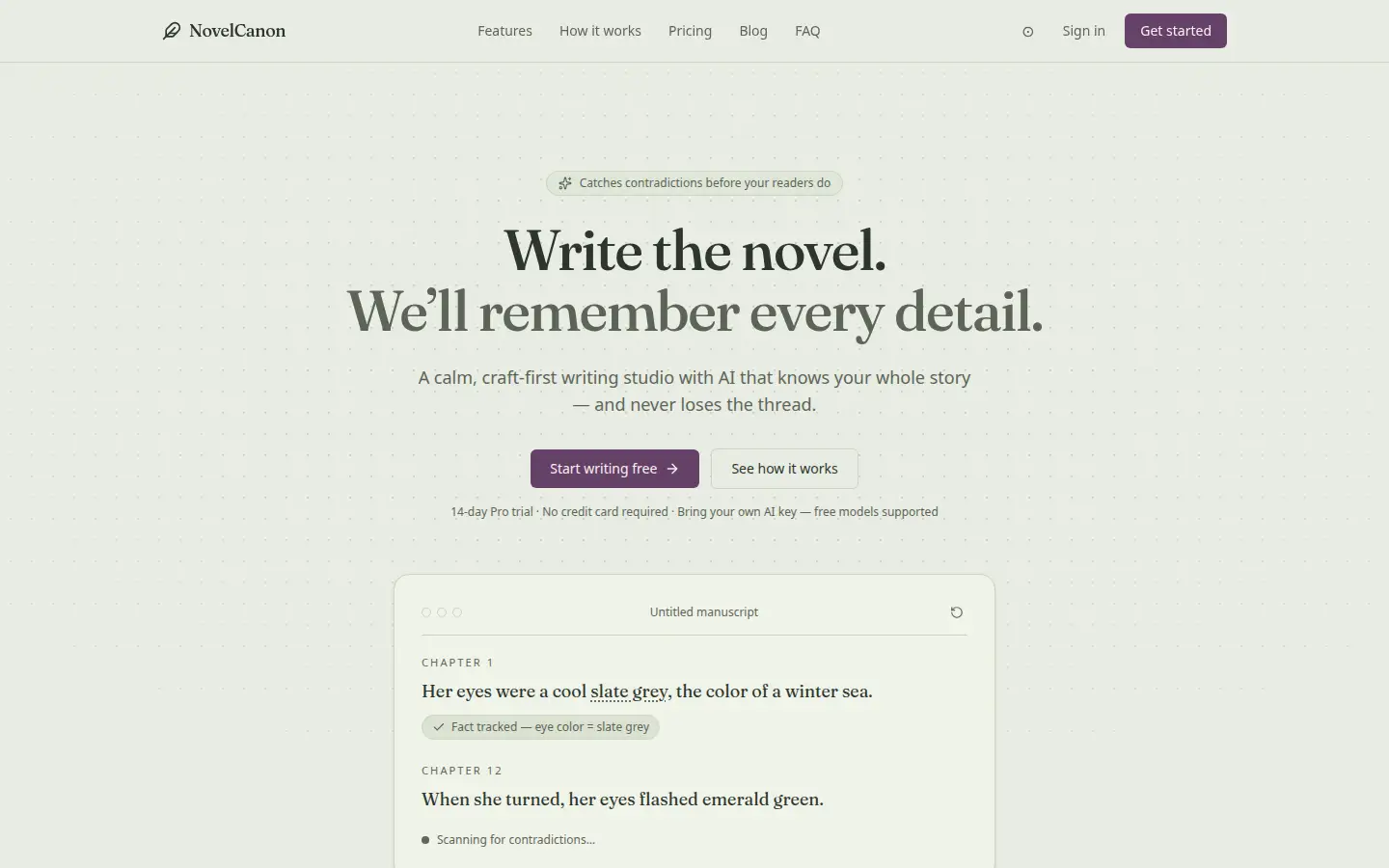
NovelCanon is a browser writing studio for a novel. The home page's line is "Write the novel. We'll remember every detail." You draft in the app. A story bible of characters, places, world rules, plot threads, and a timeline sits beside the manuscript. AI can continue a scene, rewrite a line, brainstorm, or answer in chat, using that record as context. The same page says the model acts only when you ask, and that a generated passage stays highlighted until you accept it, dismiss it, or regenerate it.
It is a product of Intelligetic, owned and operated by Munib Ali Laghari. The terms were last updated on 12 July 2026. The privacy policy was last updated on 22 October 2026. The refund page was last updated on 4 July 2026. None of those pages states a launch month. None of this is a hands-on test. It is what those pages said on 30 October 2026.
You bring your own key. OpenAI, Anthropic, Google, or OpenRouter. The subscription is for the software. The model bill goes to the provider, and the home page says there is no markup. Free models through OpenRouter are named as a way to avoid that bill. Keys are stored with envelope encryption and decrypted in memory for a request you start. The privacy policy says they are not logged.
Who it's for
- Novelists who already have, or will open, an API account. If a key is a chore you will not do, the product does not have a hosted-model fallback on the pages we read.
- Writers who want the contradiction found in the draft, not in a separate upload. The checks run in the editor. A finished file that lives in Word is the wrong shape unless you import it.
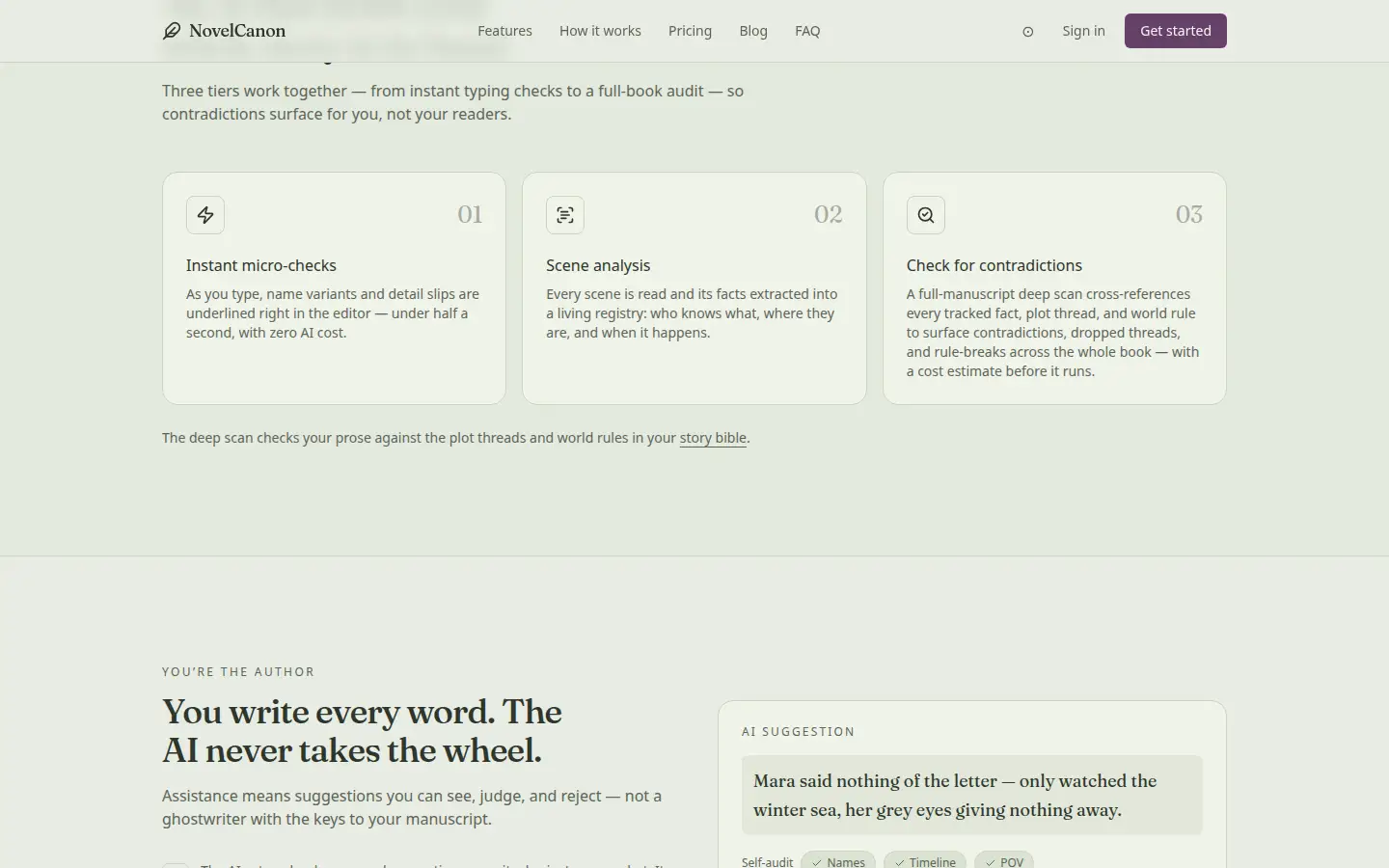
- People who will accept or reject each suggestion. The home page is written against a ghostwriter. A generated paragraph stays marked.
It is a weaker fit if you need the subscription to include the model, if the book is not in a language the pages discuss (they do not name one), or if you want a series check that reads book two against book one. Nothing on the vendor pages describes that last job.
Key features in practice
The home page describes three checks that stack.
- Instant micro-checks. As you type, name variants and detail slips are underlined in the editor, in under half a second, at zero AI cost. The pricing page puts this on every plan, including Free.
- Scene analysis. Each scene is read and its facts go into a registry: who knows what, where they are, and when. The pricing page's "fact tracking" line is on the free plan for characters and places. "Scan for new entries," which suggests new characters, places, threads, and facts for you to review, is on Manuscript and Pro, and during the trial.
- Check for contradictions. A whole-manuscript scan cross-references tracked facts, plot threads, and world rules. The home page says it shows a cost estimate before it runs. The pricing page puts this scan on Pro. The refund page uses a broader phrase, "the full Consistency Engine," and lists it among Pro-only features that pause when a subscription ends. Where those two pages draw the line differently, the pricing table is the one that names which check is on which plan.
Around that:
- Story bible. Characters, places, world rules, plot threads, and a timeline. On Manuscript and Pro, importing a manuscript drafts that bible as suggestions. Nothing is added until you accept it. The home page says that when you edit a fact away, it retires on its own.
- Beat sheets. Three-Act, Save the Cat, Hero's Journey, or your own. A beat can be linked to a scene and marked empty, in progress, or complete.
- Corkboard. Scenes as cards with summary, point of view, word count, and draft status. Drag them between chapters, or read the summaries as a list.
- Voice matching. Pro. You upload writing. The privacy policy says a sample is sent once, on your key, to build a profile of point of view, tense, rhythm, and register, plus a few short excerpts. You can view, edit, or delete the profile.
- Sprints and word goals. Timed sprints and a daily target. The home page shows a sample of 25:00 and a goal of 1,200 of 2,000. That is a picture on the page, not a limit.
- Offline. Drafts save on the device and sync when you reconnect. AI still needs a connection. The home page says you can install the site like a native app.
- Import and export. DOCX, PDF, EPUB, Markdown, plain text, or Scrivener. Free export is Markdown and plain text, and free import after the trial is the first three chapters. Manuscript adds a full import, a drafted bible, reading mode, and DOCX. Pro adds EPUB, PDF, and a full backup. The home page's shorter line, "export to publishing standards as DOCX, EPUB, and PDF," does not repeat those gates. Use the pricing page.
Pricing (checked 30 October 2026)
Every new account gets 14 days of Pro, with no card, whichever plan you were looking at. After that, the account moves to Free unless you subscribe. Paid plans are sold by Polar, the merchant of record. The charge on a statement appears via Polar. Prices on the page are dollar figures. The page does not say "US dollars."
| Plan | Billed monthly | Billed annually | What the card lists |
|---|---|---|---|
| Free | $0 | $0 | 1 project, 3 chapters, 20 AI actions a day, Markdown and plain text |
| Manuscript | $7 | $5/month ($60/year) | Unlimited projects and chapters, bible drafted on import, scan for new entries, DOCX. Still 20 AI actions a day |
| Pro | $15 | $12/month ($144/year) | Unlimited AI, voice matching, the contradiction scan, EPUB, PDF, full backup |
Pricing at a glance
Billed monthlyBilled yearly
- FreeAfter the trial: 1 project, 3 chapters, 20 AI actions a dayFree
- ManuscriptUnlimited projects; story bible drafted on import; DOCX$7/mo$5/mo
- ProUnlimited AI, voice matching, whole-book scan, EPUB and PDF$15/mo$12/mo
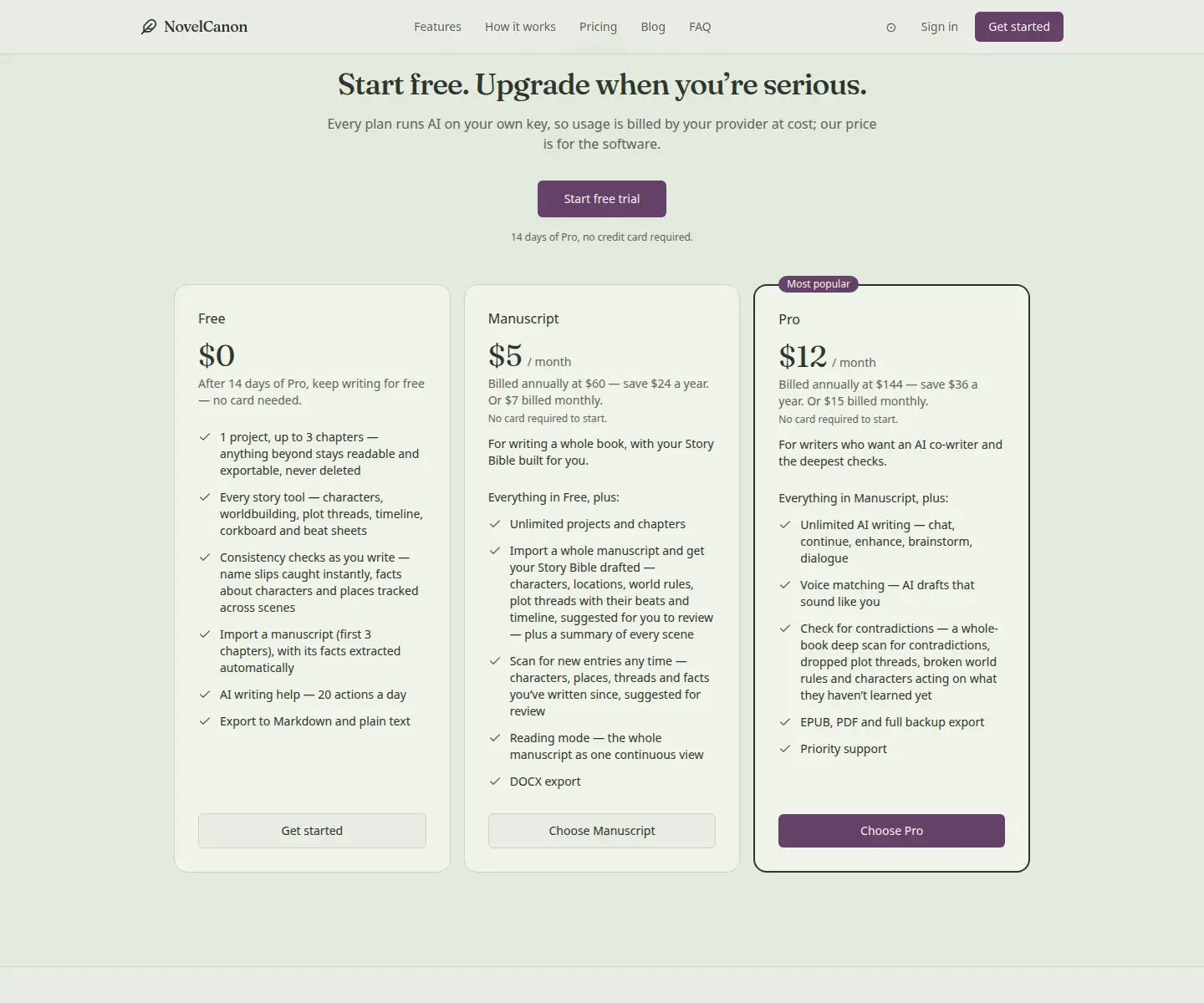
The comparison table on the same page is more precise than the cards about the 20-action cap: Free and Manuscript both say 20 a day for chat, continue, enhance, brainstorm, and dialogue. Pro says unlimited. Work past the free limits stays readable and exportable. The terms say it becomes read-only. It is not deleted.
The refund page is written for Pro. Cancel from billing settings. Pro access lasts until the period ends, then the account continues on Free with the projects still there, and Pro-only features pause. A full refund is offered within 14 days of the first Pro purchase, no questions asked. Renewal charges are "case by case." Model spend is between you and the provider. The page says nothing in the policy limits statutory rights, including an EU or UK 14-day withdrawal where it applies. Manuscript is not named in that refund paragraph.
Using it as a writer
- Use the trial on a chapter where you know a fact slips. The first check is supposed to underline it without calling a model. If it misses a slip you can see, the deeper scans are a different product and a different bill.
- Connect a key before you judge the prose. The software price is not the writing price. OpenRouter's free models are the vendor's own suggestion if you want the actions without a provider invoice.
- Accept bible notes one at a time. Import drafts them. A wrong note you accept becomes context for the next scene.
- Read the cost estimate before a whole-book scan. It is on Pro, and it spends the key, not the NovelCanon subscription.
- Export a backup while Pro is on. EPUB, PDF, and the full backup are Pro lines. Markdown is on Free.
Strengths
- The first check does not spend a model. Underlining a name slip at zero AI cost is a different promise from a chat that rewrites the paragraph.
- Suggestions stay marked. The home page says a generated passage stays highlighted until you accept, dismiss, or regenerate it.
- The software price is printed, and the model price is not hidden inside it. $5 or $12 a month on the annual cards, plus whatever the key costs.
- A plain training answer. The privacy policy says your writing is not used to train NovelCanon's models. The OpenRouter sentence is the caveat, and it is written down.
- Deletion is in the account settings. The privacy policy says residual backup copies are purged on a rolling basis. It does not give a number of days.
Writer's Toolbelt editorial scores
NovelCanon scorecard
7.8/10
- Continuity checks, as described8/10
- Price clarity8/10
- Leaves the writing to you8/10
- Privacy, as written8/10
- Fit for a working novelist7/10
Weaknesses
- Free is a sample, not a book. One project, three chapters, 20 actions a day. A manuscript you already wrote is readable past that, not a place you keep drafting for free.
- The contradiction scan is Pro, and it costs the key as well. The estimate is disclosed. The dollar amount is not, because it depends on the model you picked.
- Currency is a dollar sign. The page does not name USD. The Novel Kit's review reads the figures as US dollars. That is their reading, not a line on novelcanon.com.
- OpenRouter is a best-effort privacy ask. The policy says NovelCanon asks those providers not to retain or train, and that it cannot guarantee every downstream provider.
- No language list. The public pages do not say which languages the checks or the prose tools handle.
- The law on the terms is Pakistan. Mandatory consumer rules where you live are reserved. If that forum matters to you, read the sentence before you upload a book.
- Series continuity across books is not described. One project can hold a book. A check of volume two against volume one is not on the pages we read.
How it compares
- NovelCanon vs Sudowrite. Sudowrite sells the models inside the subscription and keeps a Story Bible you maintain. NovelCanon sells the studio and sends the draft to your key, and it drafts bible entries from the prose for you to accept. See the Sudowrite review.
- NovelCanon vs Novelcrafter. Both are bring-your-own-key. Novelcrafter's codex is something you build. NovelCanon's pricing page is written against that chore: the bible is suggested from the manuscript. See the Novelcrafter review.
- NovelCanon vs ProseEngine. ProseEngine is made by the person who runs this site. See the disclosure above. It is also a fiction studio with a codex and scene generation. We are not scoring that matchup. Run the same chapter in each.
Feature comparison
AI fiction drafting tools compared
| Feature | NovelAI | Squibler | Type.ai | Storysnap | ProseEngine | DreamGen | ScribistIQ | NovelCanon | Fiktion |
|---|---|---|---|---|---|---|---|---|---|
| Free plan | Yes | Yes | Yes | No | Yes | YesLimited credits; the free credit count is not printed in the FAQ answer | NoFree first chapter only, about 500 to 700 words | YesAfter a 14-day Pro trial: 1 project, 3 chapters, 20 AI actions a day | YesBasic is lasting and free: 1 book, up to 10,000 words |
| Lowest listed paid price | Yes$10 | Yes$15.83 | Yes$8 | Yes$45 | Yes€8 | Yes$7.83 | Yes$29 | Yes$5 | Yes$14.99 |
| All paid tiers have published prices | Yes | Yes | Yes | Yes | Yes | Yes | Yes | Yes | PartlyHome page prints Basic, Professional, and Premium. The terms name only Pro at $14.99/month |
| Competes with ProseEngine (we disclose) | Yes | Yes | Yes | Yes | Yes | Yes | Yes | Yes | Yes |
Verdict
NovelCanon is a drafting desk with the continuity check built into the typing, and with the model bill left on your key. That split is the product. The pages are specific about which check is free, which arrives with Manuscript, and which waits for Pro.
Start the trial on a chapter you can fact-check yourself. If the underline catches the slip and the marked suggestion is something you would edit rather than paste, Manuscript is the plan that holds a whole book at twenty actions a day. If you want the model in every scene and the whole-book scan, Pro is the card, and the provider invoice is part of the price. If you will not keep a key, this is the wrong studio.
FAQ
Is NovelCanon free? Yes, after a 14-day Pro trial that needs no card. Free is one project, up to three chapters, and 20 AI actions a day. Work beyond that stays readable and exportable. It is not deleted.
How much does it cost? On 30 October 2026, Manuscript was $5 a month billed annually ($60 a year) or $7 billed monthly. Pro was $12 a month billed annually ($144 a year) or $15 billed monthly. The page prints dollar signs and does not name a currency. Your model provider bills separately.
Does NovelCanon train on my manuscript? The privacy policy says no. Requests go to the provider behind your key. The policy says it cannot guarantee that every model reached through OpenRouter will honour a no-training request.
Do I need an API key? Yes. The pricing page and the FAQ on the home page both say so. OpenAI, Anthropic, Google, or OpenRouter.
Who runs it? Munib Ali Laghari, under the name Intelligetic. The terms use the laws of Pakistan. You must be at least 13.
Free guide
The 10 best free AI tools for writers
Join the Writer's Toolbelt newsletter for a short note when the shelves change, and get the free PDF guide.
Nearby on the shelf
Drafting
AuthorFlows
A browser studio for novels: an outline generator, a paginated editor, character cards, a story map, a timeline, and a Story Analyzer you run on purpose. The home page says the manuscript is never used to train a model, and that you can turn generation off. There is no free plan on the pricing section. The privacy policy and terms on the site say they take effect on 16 November 2026.
Best for Fiction writers who want outline, cast, and a chapter editor in one browser tab, and who will pay before they can try a manuscript.
SubscriptionFictionDrafting
ChatGPT
The general assistant most writers already have open. Useful for brainstorming, blurb variants, and line rewrites if you paste the scene and say what you want. It does not hold a novel together unless you build that memory yourself with projects or files, and it will invent sources if you let it.
Best for Writers who want one flexible assistant and will bring their own outline, pages, and skepticism.
FreemiumFiction and nonfictionDrafting
Claude
A general assistant that writers often prefer for long passages, tone, and a calmer revision pass. Projects can hold notes and chapters you upload. It is still a chat, not a novel app: continuity across a whole book is only as good as the pages you put in front of it.
Best for Drafting and revision when you want a careful reader more than a plot machine.
FreemiumFiction and nonfiction