After the draft exists
Wordsmith
Fred, Wordsmith's AI editor, reads a whole manuscript (about 150,000 words) or a short piece (about 15,000), gives an overall read and the one thing to fix first, then notes and line edits you accept or reject. A full manuscript comes back as a marked-up document. It does not rewrite the book. The manuscript plan also covers typesetting, covers, and a market-fit pass, and Wordsmith learns which suggestions you keep.
Best for
Novelists, memoirists, and nonfiction writers revising a full draft who want notes and line edits they can accept or reject.
Pricing
Freemium. Free to start, no card. On 30 October 2026 the pricing page showed Essays at $10/month and Manuscripts at $50/month. The page script prices a quarter at 10% off: $27 ($9/month) and $135 ($45/month). Manuscripts includes editing, typesetting, cover design, and market fit. Managed publishing is $999 per book, paid once, and is subject to fit.
Checked 30 October 2026. Plans move. The vendor's page wins an argument with this one.
Good to know
At a glance
- Availability
- Open beta. The terms (updated 26 May 2026) say it is operated by Euwyn Goh and Yash Wanvari, pending incorporation. Country blocks: not stated.
- Platforms
- Web, and from inside ChatGPT if you connect the account. The privacy policy names Google sign-in. Mobile apps: not stated.
- Languages
- The $999 publishing offer is for an existing English-language prose manuscript. A language list for Fred is not stated.
- Launched
- Launched not stated
- Independent reviews
- No independent reviews found as of 30 October 2026.
- AI training and retention
- Does not train on manuscripts, and you own the content. Stored encrypted on Neon (Postgres). Text goes to Inception Labs (Mercury) and OpenAI under API terms that forbid training. They learn from which suggestions you accept or reject; the terms say that signal excludes the words. PostHog analytics, including session recordings, are stored in the US.
In-depth review
Wordsmith review
Last checked 30 October 2026 against the vendor's public pages. Prices and features change; check the vendor before you buy.
Disclosure: The person who runs Writer's Toolbelt also makes ProseEngine, an AI fiction-writing app that competes with Wordsmith. This review sticks to verifiable facts and links its sources below.
Writer's Toolbelt review
Wordsmith
Fred reads a full manuscript, names the one thing to fix first, and offers line edits you accept or reject. It does not rewrite the book.
- to start, no card
- Manuscripts per month
- managed publishing, once per book
Full disclosure: I also build ProseEngine, an AI fiction-writing tool listed on the same terms as everyone else.
What it is
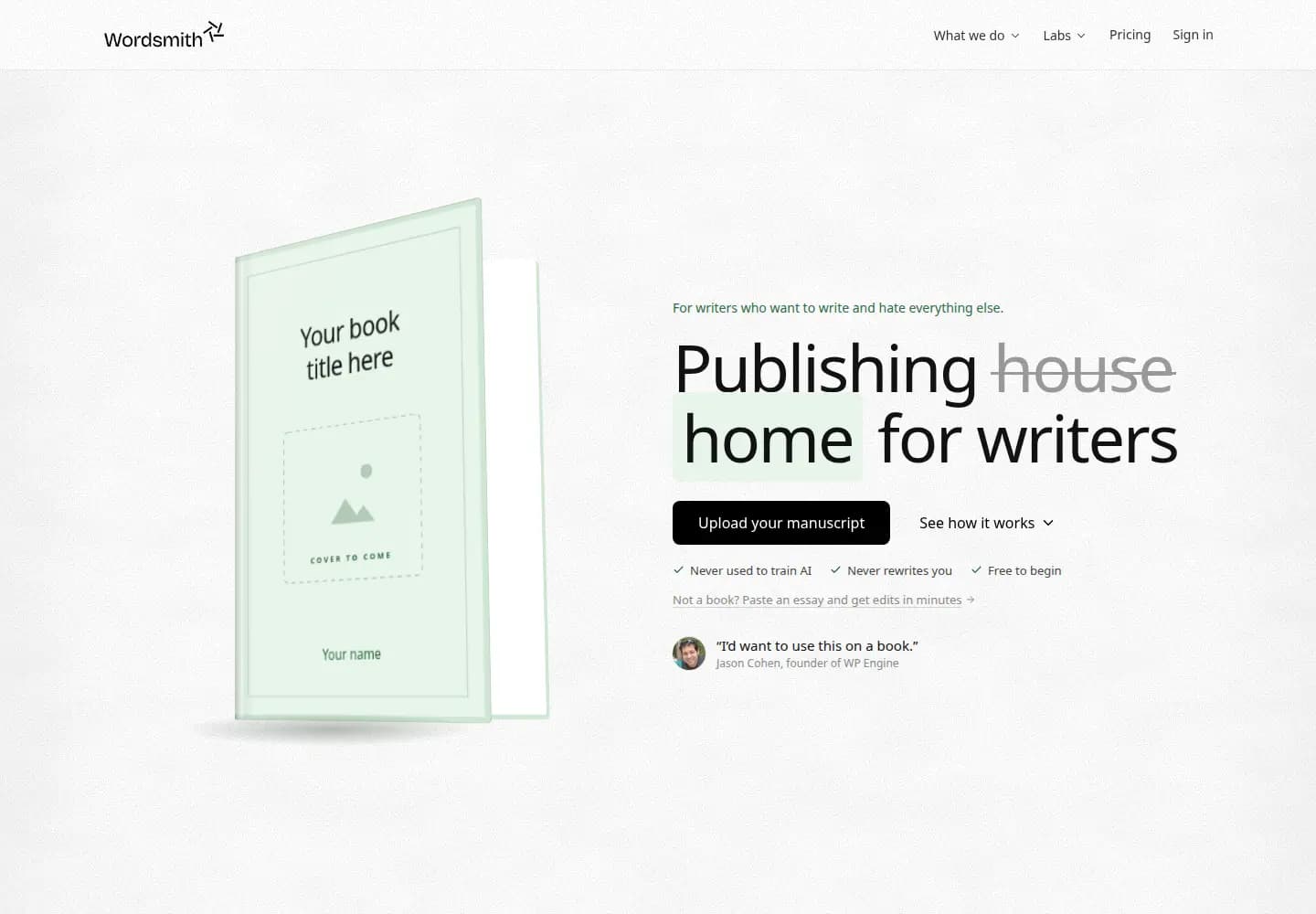
Wordsmith is an AI editorial platform. The editor is called Fred. The home page's how-it-works text says Fred first gives his read of the whole book and the one thing to fix first, then suggests a light line edit with his reasoning, and the page updates once you accept it. On the Edit step of that demo, the visible heading is "Fred reads it all, then shows the fix," and a sample read names the one thing to fix first. The demo is the vendor's example, not a manuscript we supplied. The home FAQ says a short piece, up to about 15,000 words, goes through the short-piece editor, and a full manuscript, up to about 150,000 words, goes through the manuscript pipeline, is edited in one pass, and comes back as a marked-up document.
The terms, last updated 26 May 2026, call it a tool authors use to edit their own writing, and say it is not a tool that generates writing on the author's behalf. They say Wordsmith does not author new passages, generate prose from a prompt, or ghostwrite, and that it does not rewrite the work wholesale. Line suggestions are alternative phrasings you accept or reject. The service is in open beta, operated by Euwyn Goh and Yash Wanvari, pending incorporation. You have to be at least 18, or the age of majority where you live if that is higher.
This review is what those public pages said on 30 October 2026. It did not upload a manuscript, open an account, or buy a plan.
Who it's for
- Novelists, memoirists, and nonfiction writers with a full draft. The home FAQ says Fred is for fiction, memoir, personal essays, and longform, and that it also takes structural questions in essays of ideas and nonfiction: what to develop, what to cut, what the argument is doing.
- Writers who will accept or reject each note. The manuscript card says you chat with Fred and accept or reject every suggestion. The terms put the decision on you, and they say suggestions can contain errors, factual inaccuracies, or omissions.
- A weaker fit if you want a model to continue the chapter, or a finished book from a prompt. The terms forbid that job. It is also a weaker fit if the book is longer than about 150,000 words. The FAQ's ceiling is "about" that number. The pages we read do not say what happens to the words past it.
The $999 publishing offer is narrower still. The pricing page limits it to an existing English-language prose manuscript with a substantial or final draft, where you hold the rights, and says it is subject to fit and a written book proposal.
Key features in practice
The manuscripts page describes two altitudes of edit: structural notes that move the book, and line edits that tighten the sentence, each with the reasoning, each yours to accept. It also says Fred reads chapter by chapter and keeps a map of characters, threads, and promises, so a later chapter is read knowing an earlier one. Strong passages, that page says, are left alone, and you leave with a developmental letter. The same page says accepted upload formats are Word, PDF, EPUB, Markdown, plain text, or AsciiDoc, up to 25 MB, and that you review the imported structure before the read starts. A demo on that page is labeled an illustrative example, not feedback on your draft.
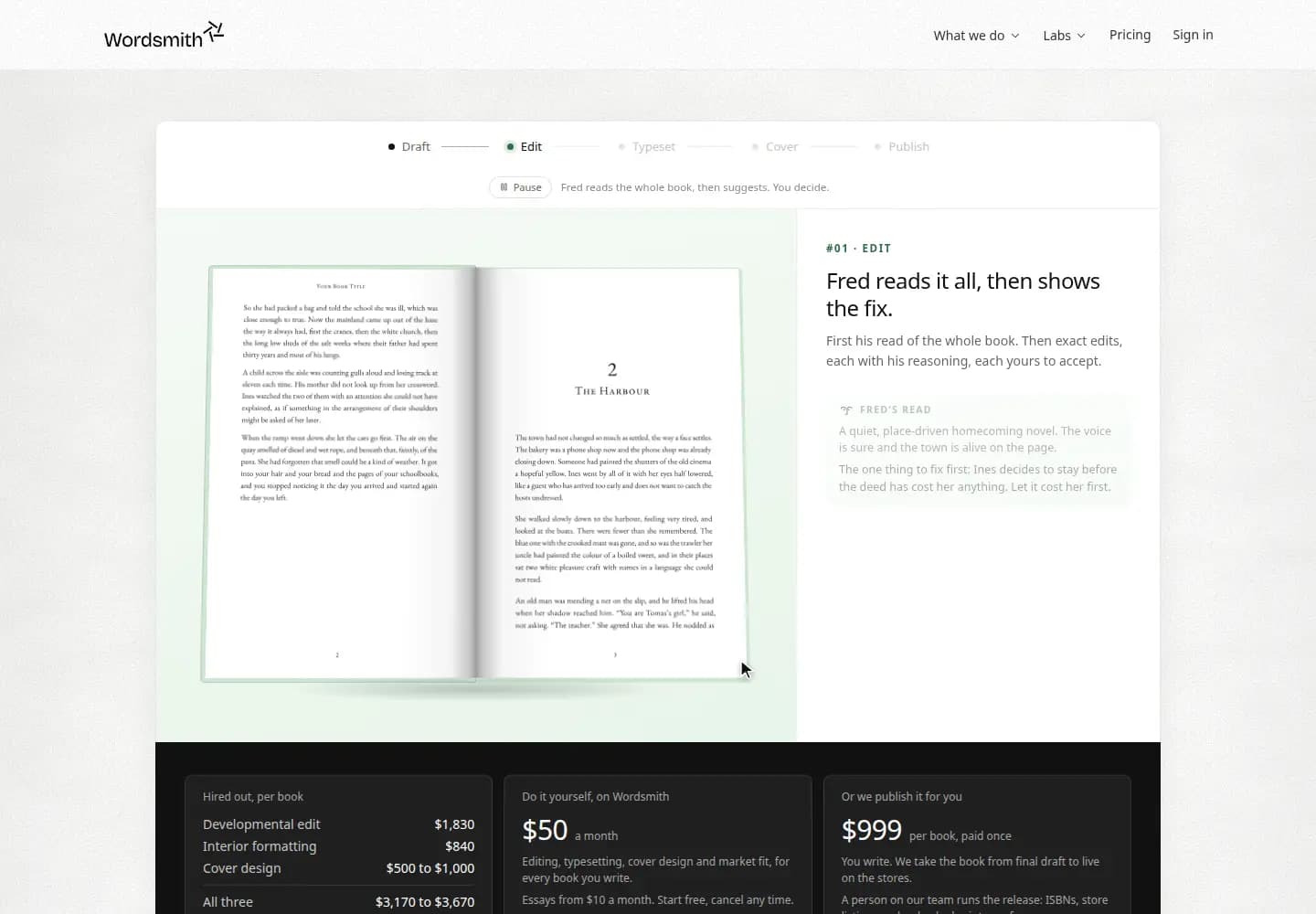
On the $50 Manuscripts plan, the pricing card adds more than the edit:
- Iris, described as a panel of beta readers chosen for your book.
- Typesetting for every manuscript. The home page's how-it-works text names three styles on the demo: Romantic, Thriller, and Editorial.
- Cover design with Fred, up to 20 generations a month.
- Market fit: whether it will sell, where, and what would help, with your Amazon listing and query letter written.
- Launch images from the cover: 3D mockups, Amazon A+ panels, and ad sizes.
- Export to DOCX and letter PDF.
Essays, at $10 a month, are the short-piece plan: unlimited essays, unlimited editorial passes, and chat with Fred on every piece. The schema.org offer on the pricing page caps those pieces at 15,000 words, which matches the home FAQ.
Managed publishing is a different product. The pricing page says a person, named there as Euwyn Goh, runs the release: Fred's edit, Iris, typesetting, cover, and market fit, plus ISBNs for print and ebook registered in your name, Amazon KDP and IngramSpark listings, description, categories, and keywords, and a printed proof checked before anything goes on sale. Every right and every royalty stays yours. The page says store setup does not guarantee stocking, readership, or sales, and that writing a book from scratch, translation, audiobooks, and complex illustrated layouts need a separate scope. The button opens an email draft. It does not send the inquiry, and it does not ask for the manuscript as an attachment.
Pricing (checked 30 October 2026)
The pricing page opens on monthly billing. A quarterly toggle is labeled as a 10% saving. The dollar amounts for that quarter are computed in the page script: base prices of $10 and $50, times three months, times 0.9. Half-year and yearly discounts exist in the same script and are not intervals the essay or manuscript plans offer.
| Plan | What the page shows | What you get |
|---|---|---|
| Free | $0, no card | Essays: 3 pieces a month, 5 passes each. Manuscripts: Fred marks up 7 chunks (about 10,000 words) of any book, free for 7 days |
| Essays | $10/month, or $27/quarter ($9/month) in the script | Unlimited short pieces, unlimited passes, chat with Fred |
| Manuscripts | $50/month, or $135/quarter ($45/month) in the script | Unlimited manuscripts and whole-book passes, Iris, typesetting, covers, market fit, launch images, DOCX and letter PDF |
| Managed publishing | $999 per book, once | A person takes a final draft through store setup. Subject to fit and a written proposal |
Pricing at a glance
- Free3 essays a month, 5 passes; 7 manuscript chunks for 7 daysFree
- EssaysShort pieces. Quarterly is $9/month in the page script$10/mo
- ManuscriptsEdit, typesetting, covers, market fit. Quarterly is $45/month in the script$50/mo
- Managed publishingSubject to fit. English-language prose
$999 once
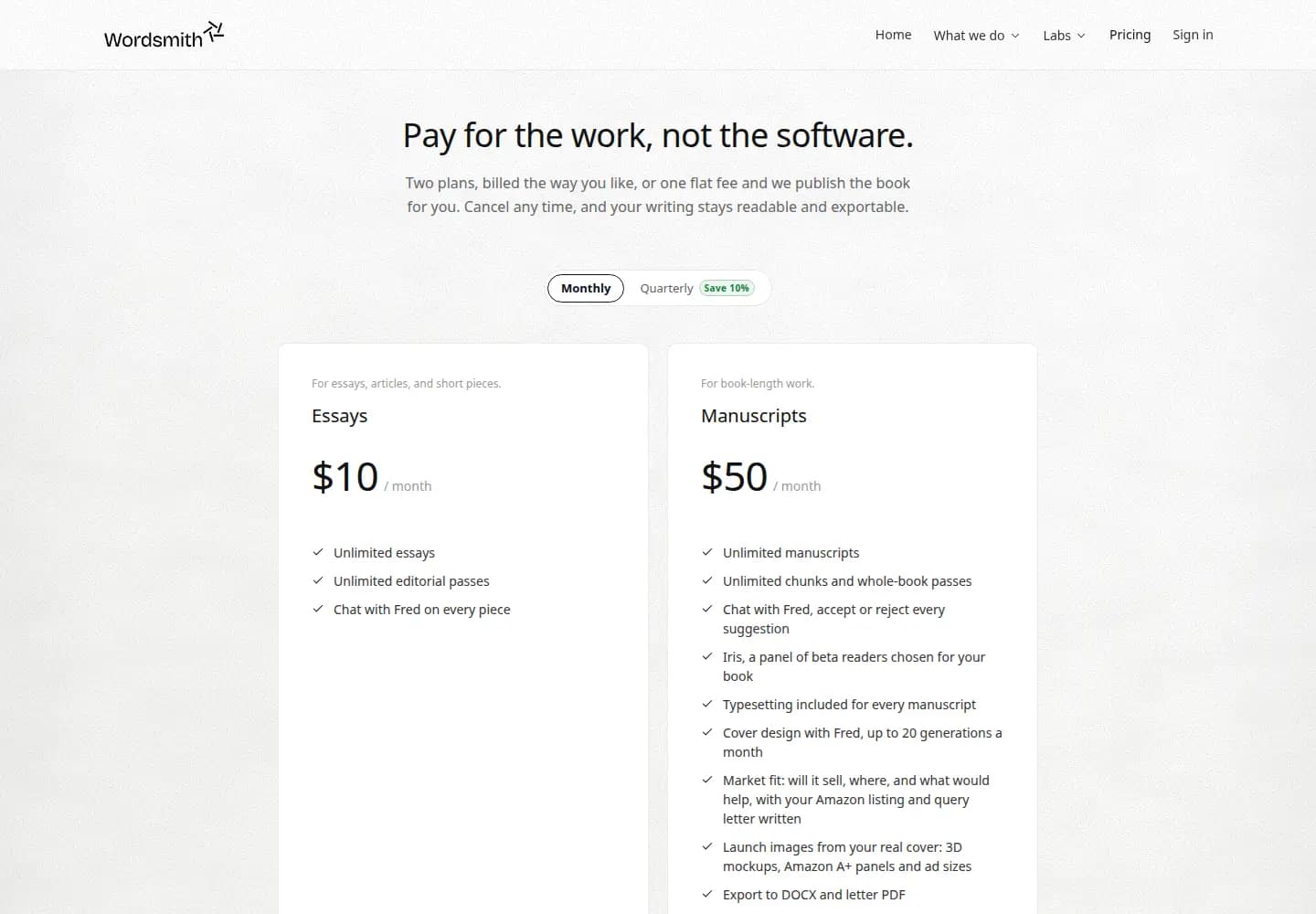
The home page sets a "Hired out, per book" column beside that $999: developmental edit $1,830, interior formatting $840, cover design $500 to $1,000, and a total it prints as $3,170 to $3,670. Those are the page's comparison figures. They are not a receipt from a freelancer.
Cancel from Billing or the Stripe portal. Access lasts until the end of the period you paid for. When a subscription ends, manuscripts stay where they are, read-only: you can open, read, export, and delete them. Chat, suggestions, and editing return if you resubscribe. Essays fall back to the free plan. The pricing FAQ says subscriptions are not refunded pro rata. The terms say payments are non-refundable except where the law requires it, and that a one-off purchase is non-refundable once the edited work has been delivered. Stripe processes the card. Wordsmith says it does not store the card details.
Prices on the schema.org offers are USD.
Using it as a writer
- Spend the free manuscript sample on a chapter whose problem you already know. Seven chunks, about 10,000 words, for seven days, with no card. If the note misses a fault you can see, the rest of the book is a different purchase.
- Accept or reject one suggestion at a time. The terms say a suggestion can be wrong. A marked-up document is still a suggestion until you take it.
- Read the Manuscripts card as several jobs on one bill. Editing, beta readers, typesetting, covers, and a market-fit pass are listed together. The market-fit line includes an Amazon listing and a query letter written for you. That is a different kind of sentence from a line edit.
- If you open Fred from ChatGPT, read the privacy policy's ChatGPT section first. The parts of your work and of Fred's output that answer the request are sent to OpenAI, under OpenAI's own terms.
- Treat $999 as a conversation, not a checkout. The page asks for draft stage, rough word count, and the help you need, and it says the scope is agreed before payment.
Strengths
- The job is a read, then a decision. The FAQ's contrast with a general chatbot is that Fred is not supposed to regenerate the paragraph. You accept, reject, or argue with a note.
- The ceilings and the prices are printed. About 15,000 words, about 150,000 words, $0, $10, $50, and $999. The free start does not ask for a card.
- Training on the manuscript is a direct no, and the providers are named. The terms name Inception Labs (Mercury) and OpenAI. The home FAQ says those API terms forbid training on your text. You keep the rights in the manuscript, in edits you accept, and in the chat with Fred.
- Deletion has an address. The privacy policy and the home FAQ both say to email euwyn@wordsmith.page or yash@wordsmith.page.
Writer's Toolbelt editorial scores
Wordsmith scorecard
7.2/10
- Whole-manuscript read, as described8/10
- Leaves the sentences to you8/10
- Price clarity7/10
- Privacy, as written6/10
- Fit for a full-draft revision7/10
Weaknesses
- Wordsmith learns from which suggestions you accept or reject. The home FAQ calls that the only learning signal, and says it never includes your words. The terms say the same, and add that the data is anonymized at training time, "as set out in our Privacy Policy." The privacy policy, last updated 25 October 2026, does not describe that signal. The learning is the caveat. The promise that the words stay out of it is in the FAQ and the older terms.
- PostHog session recordings are on, and they are stored in the United States. The privacy policy says recordings never capture the text of a manuscript or essay, that the editor and book pages are left out of every recording, and that form fields are masked. That exclusion is the vendor's description of the recording. The recording itself is still part of the product.
- The privacy policy says Wordsmith does not use third-party advertising cookies or cross-site tracking. On 30 October 2026 the production HTML, and only when the hostname is wordsmith.page, loads ChatGPT ads measurement pixels. The same pages load a Google tag and, on that hostname, a Google Ads config tag. The policy sentence and the page source are both on the record.
- It is an open beta, and the operators are two named people, pending incorporation. The terms disclaim warranties, cap liability at the greater of what you paid in the prior twelve months or USD 100, and say features may change, break, or be removed.
- The quarterly prices are in the script, not in the first paint of the card. The monthly figures are what the page shows before you toggle. The $999 number is printed, and the same page says the offer depends on fit.
How it compares
- Wordsmith vs AutoCrit. AutoCrit is a subscription of fiction reports, genre comparisons, and alpha and beta readers you steer. Wordsmith's Manuscripts plan is also a monthly bill, and it adds typesetting, covers, and a market-fit pass on the same card. AutoCrit's home page says it will not write the book. Wordsmith's terms say it will not ghostwrite, and they still allow a suggested line you can reject. See the AutoCrit review.
- Wordsmith vs ProWritingAid. ProWritingAid is the manuscript style report: repeats, pacing, sticky sentences, plus story reports that spend credits. Wordsmith's own FAQ sets Fred apart from that category and says a rule-checker does not read the piece as a piece. ProWritingAid's free cap is 500 words at a time. Wordsmith's free manuscript sample is about 10,000 words for seven days. See the ProWritingAid review.
- Wordsmith vs Inkshift. Inkshift sells a written critique of a fiction manuscript, from a free 10,000 words up to $100 once, and it does not bundle typesetting. Wordsmith is a subscription you work inside, plus an optional $999 publishing service. See the Inkshift review.
- Wordsmith vs ProseEngine. ProseEngine is made by the person who runs this site. See the disclosure above. It is a fiction studio with generation in the margin. Wordsmith's terms say it does not generate the book. We are not scoring that matchup. The free sample is the part you can judge without paying either of them.
Feature comparison
Manuscript feedback tools compared
| Feature | AutoCrit | Fictionary | Marlowe | DeepL Write | Novel Maestro | Inkshift | Outline Analyzer | Wordsmith |
|---|---|---|---|---|---|---|---|---|
| Free plan | Yes | No | Yes | Yes | YesOne whole-book read, lifetime of the account | YesFirst 10,000 words free | NoDemo with five sample outlines only | YesNo card. Essays: 3 a month. Manuscripts: 7 chunks, about 10,000 words, for 7 days |
| Lowest listed paid price | Yes$15 | Yes$14 | Yes$13.25/mo annual ($19.95 monthly) | YesUS listing 16 Oct: $8.74. German page 23 Oct: Write add-on €6.99. Check vendor | Yes$79 once, then $19 a further read | Yes$25 once for a critique | Yes$4.99 once (launch price) | Yes$45/mo quarterly for manuscripts ($50 monthly). Essays are $9/$10 |
| All paid tiers have published prices | Yes | Yes | Yes | Yes | PartlyCard now says $79 once, permanent access, and $19. About page still says they are not taking payments. | YesCards print $25, $35, and $100. 5-packs are in the page's product data. | Yes | Partly$10, $50, and $999 are printed. Quarterly amounts are in the page script at 10% off. The $999 offer is subject to fit. |
| Competes with ProseEngine (we disclose) | Yes | Yes | Yes | No | Yes | Yes | Yes | Yes |
Verdict
Wordsmith is an editor for a draft that already exists. Fred is described as a whole-manuscript read, one priority, and line edits you accept or reject, returned as a marked-up document for a full book. The $50 plan is that edit plus typesetting, covers, beta readers, and a market-fit pass. The $10 plan is the short piece. The $999 path is a person and a proposal.
Start with the seven free chunks if the book is the point, or with the three free essays if it is not. Read a suggestion before you accept it. The terms already say it can be wrong, and the company keeps a record of which ones writers keep. If you need the chapter written rather than marked up, this is the wrong tool. The terms say so.
FAQ
Is Wordsmith free? Yes, with no card. Essays: 3 pieces a month, 5 passes each. Manuscripts: 7 chunks, about 10,000 words, for 7 days. After that, the pricing page shows Essays at $10/month and Manuscripts at $50/month.
How much does it cost? On 30 October 2026, Essays were $10 a month and Manuscripts were $50 a month, in USD. The page script prices quarterly billing at 10% off: $27 and $135 for the quarter. Managed publishing is $999 per book, paid once, and the page says it is subject to fit. Subscriptions are not refunded pro rata.
Does Fred rewrite the book? The terms say no. Wordsmith does not ghostwrite, generate prose from a prompt, or rewrite the work wholesale. It can propose a line, with a reason, for you to accept or reject. A full manuscript is returned as a marked-up document. This review did not upload a manuscript.
Does Wordsmith train on my manuscript? The home FAQ and the terms say no, and that you own what you upload. Text is stored encrypted on Neon, a managed Postgres host, and sent to Inception Labs (Mercury) and OpenAI. The FAQ says those API terms forbid training. They do learn from which suggestions you accept or reject. The terms say that signal excludes the words.
What is stored besides the manuscript? The privacy policy says PostHog records product analytics and session recordings, stored in the United States, and that those recordings leave out the editor and the book pages. Using Wordsmith from inside ChatGPT sends the relevant text and Fred's reply to OpenAI under OpenAI's terms. The production site also loads ChatGPT ads measurement pixels.
Who runs it? Euwyn Goh and Yash Wanvari. The terms, updated 26 May 2026, say the service is an open beta pending incorporation. You must be at least 18. Deletion requests go to euwyn@wordsmith.page or yash@wordsmith.page.
Free guide
The 10 best free AI tools for writers
Join the Writer's Toolbelt newsletter for a short note when the shelves change, and get the free PDF guide.
Nearby on the shelf
Editing
AutoCrit
Fiction editing reports for dialogue, pacing, repetition, and overused phrasing, plus a story analyzer and AI alpha and beta readers you can steer with instructions. Pro also includes Market Fuel for promotional angles. The reports compare your draft with genre tendencies, which is a clue, not a verdict. It will not write the book for you.
Best for Novelists who want genre-aware notes on a complete draft, not a chatbot that continues the scene.
SubscriptionFictionDrafting
Claude
A general assistant that writers often prefer for long passages, tone, and a calmer revision pass. Projects can hold notes and chapters you upload. It is still a chat, not a novel app: continuity across a whole book is only as good as the pages you put in front of it.
Best for Drafting and revision when you want a careful reader more than a plot machine.
FreemiumFiction and nonfictionEditing
DeepL Write
Rewrite suggestions from the company behind DeepL translation. It is aimed at clearer phrasing, not plot. Particularly useful if you draft between languages or want a second wording that is conservative rather than clever. It will happily smooth a sentence that was supposed to be sharp.
Best for Nonfiction clarity, and writers moving between languages who want phrasing help rather than a story engine.
FreemiumNonfiction