After the draft exists
Inkshift
A web critique for fiction manuscripts from Inkshift Inc. in Canada. You upload a draft and get a written report on structure, pacing, character, and genre, with optional chapter plans and line-level markup. The first 10,000 words are free. It is a report, not a writing studio, and the terms say the notes can be wrong.
Best for
Fiction writers who want a paid whole-draft critique without a subscription, and who will decide which notes to keep.
Pricing
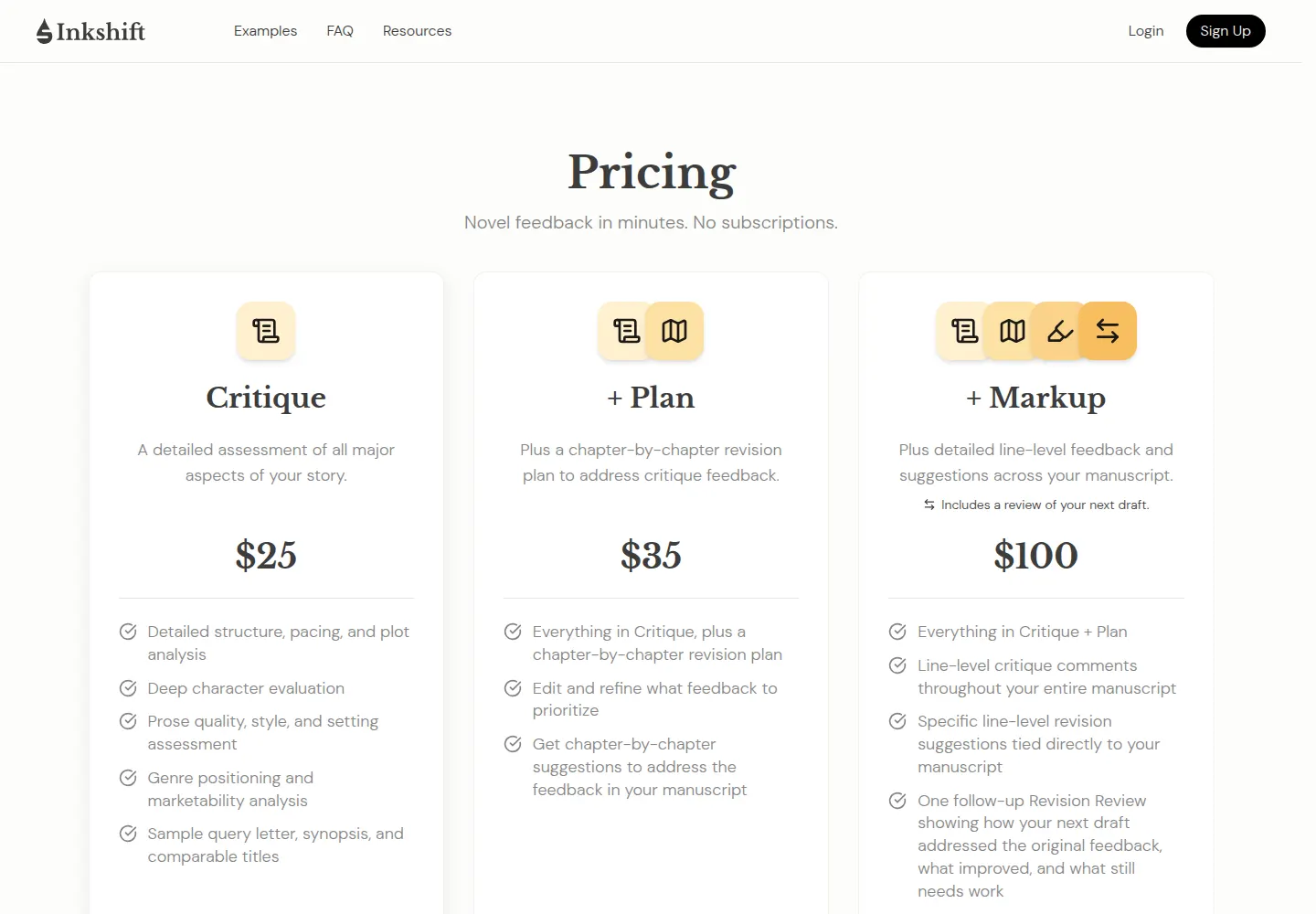
Freemium. Pay per critique, no subscription. On 28 October 2026 the pricing cards showed Critique $25, + Plan $35, and + Markup $100, which includes one review of the next draft. Starter is free for the first 10,000 words. The page's product data also lists 5-packs at $100, $140, and $400. Prices are USD. The terms say fees are non-refundable except where the law requires it.
Checked 28 October 2026. Plans move. The vendor's page wins an argument with this one.
Good to know
At a glance
- Availability
- not stated. Inkshift Inc. is a Canadian federal company. The terms use the laws of British Columbia. Prices are in US dollars. Country blocks: not stated.
- Platforms
- Web. The privacy policy says sign-in is Google or email. Mobile apps: not stated.
- Languages
- The pricing FAQ says Inkshift can analyze manuscripts in almost any language, and that the critique report is currently returned in English.
- Launched
- Launched not stated
- Independent reviews
- Edith Edits, which sells its own editorial letters, published “inkshift Review (2026)” on 29 September 2026, updated 26 October 2026.
- AI training and retention
- Privacy policy (30 July 2026): neither Inkshift nor its AI providers use Your Content to train models. The providers are not named. Without a storage feature, the manuscript is deleted from active systems shortly after the report. Outputs stay in the account until you delete the project. Account deletion removes stored manuscripts within 30 days.
In-depth review
Inkshift review
Last checked 28 October 2026 against the vendor's public pages. Prices and features change; check the vendor before you buy.
Disclosure: The person who runs Writer's Toolbelt also makes ProseEngine, an AI fiction-writing app that competes with Inkshift. This review sticks to verifiable facts and links its sources below.
Writer's Toolbelt review
Inkshift
A pay-per-critique report on a fiction manuscript. The first 10,000 words are free. The notes are the vendor's, and the terms say they can be wrong.
- starter critique, first 10,000 words
- full critique, once
- markup, including one next-draft review
What it is
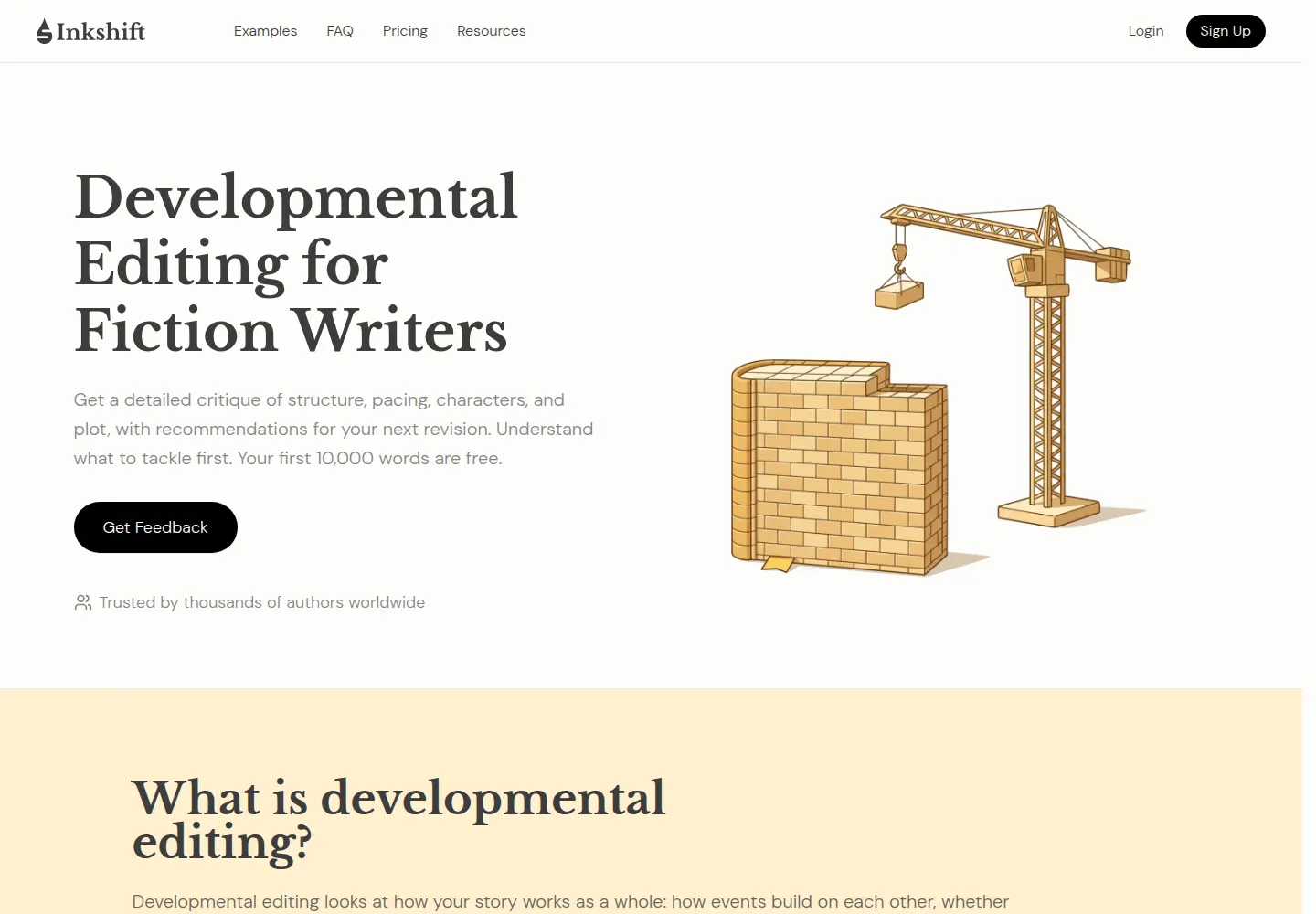
Inkshift is a web service that reads a fiction manuscript and returns a written critique. The home page's line is "Professional-grade novel feedback in minutes," and the subhead names plot, pacing, character development, and prose. The developmental-editing page is more specific about the job: a report on how the story works as a whole, so you can decide which changes will matter on the next draft. It says you decide which of those changes support what you meant the book to be.
The company on the terms and the privacy policy is Inkshift Inc., a federally incorporated company in Canada, based in British Columbia. The terms are governed by the laws of British Columbia and the federal laws of Canada. Support and billing questions go to hello@inkshift.io. The terms were last updated 5 August 2026. The privacy policy was last updated 30 July 2026. Neither page gives a launch month for the product. This review uses those dates as policy dates, not as a launch date.
This review is based on the public pages listed below, read on 28 October 2026. We did not upload a manuscript, buy a critique, or open an account. Nothing here is a measurement of how specific the notes are.
The home page prints "20,000+ manuscripts analyzed" and short quotations, including "Exactly what I need to improve as an author." Those are the vendor's figures and the vendor's page. We did not audit the count, and a quote on the company's own home page is not an outside review.
Who it's for
- Fiction writers with a draft they are willing to upload. The developmental page says a complete draft gives the clearest picture of structure, payoff, and character. It also says you can submit an excerpt, and that a report on an excerpt can only judge what is in that file.
- Writers who want the notes as a document, then will make the changes themselves. The same page describes Inkshift as a written assessment that arrives in minutes, next to human options it prices as "varies" and "by agreement": a developmental editor, a manuscript assessment, and a writing coach.
- A weak fit if you wanted a manuscript desk you live in, a model that continues the chapter, or a nonfiction citation tool. The site also lists screenplays, fanfiction, and a query-letter generator. Those are separate pages. This review is about the critique the pricing cards sell.
You must be at least 18, or the age of majority where you live if that is higher, to make an account. The privacy policy says the service is not for children who are not eligible to use it.
Key features in practice
The features below are what the pricing cards, the developmental-editing page, the terms, and the privacy policy say. They are the vendor's description.
- Three paid depths, and a free opening. The cards on 28 October 2026 were Critique at $25, + Plan at $35, and + Markup at $100. Critique lists structure, pacing, and plot; character; prose, style, and setting; genre and marketability; and a sample query letter, synopsis, and comparable titles. + Plan adds a chapter-by-chapter revision plan and suggestions tied to the manuscript. + Markup adds line-level comments, line-level revision suggestions, and one follow-up Revision Review of the next draft: what improved, and what still needs work. Starter, named on the pricing page and on the developmental page, is free feedback on the first 10,000 words.
- 5-packs sit in the page's product data. The pricing FAQ says a 5-pack is for several drafts, books, or projects, that each credit includes that tier, and that every Markup credit also includes a Revision Review of the next draft. The same page's structured product data lists five editorial critiques for $100, five revision plans for $140, and five markup critiques for $400, each described as a saving against five singles. Those pack prices were not on the three cards in the screenshot. They are on the page. Check the control you click.
- A fresh read is a new purchase. The pricing FAQ says each critique is a fresh read of the manuscript you submit. Markup's Revision Review is the comparison against the manuscript already stored in that project. It is not a second full critique by another name.
- What the report is supposed to cover. The developmental page lists story structure and scene purpose, pacing and escalation, character motivation and emotional payoff, plot logic and point of view, and theme, narrative distance, and genre expectations. It says the report also considers prose and setting where they affect the story. It does not publish a word cap, a file-type list, or a minute count on the pages we read. Edith Edits' review states figures for those. This page does not copy them. Check the upload screen.
- It suggests. The terms do not promise the suggestion is right. Section 8 says service outputs may be generated in whole or in part by AI, are for information and suggestion only, and may contain generic, inaccurate, or non-original phrasing. You are responsible for reviewing them before you use them. The developmental page's own order of work is structure first, then prose, then proofreading, and it says a structural revision can make you throw out sentences you already polished. That is their advice about sequence, not a promise that the markup will refuse to touch a sentence.
Pricing (checked 28 October 2026)
The pricing page's heading is "Novel feedback in minutes. No subscriptions."
| Option | Price on the card or in the product data | What the page says you get |
|---|---|---|
| Starter | $0 | First 10,000 words, so you can see the style of the notes |
| Critique | $25 once | Structure, pacing, plot, character, prose and setting, genre and marketability, sample query, synopsis, comps |
| + Plan | $35 once | Critique, plus a chapter-by-chapter revision plan |
| + Markup | $100 once | Plan, plus line-level comments and suggestions, and one Revision Review of the next draft |
| 5-packs | $100, $140, or $400 | Product data on the same page. Five of critique, plan, or markup |
Pricing at a glance
- StarterFirst 10,000 wordsFree
- Critique
$25 once
- + Plan
$35 once
- + Markup
$100 once, plus one next-draft review
The terms say fees are in US dollars unless the page says otherwise, are due in full before the report is delivered, and are non-refundable except where the law requires it. If you think the charge is wrong, or you are dissatisfied, the terms say to write to hello@inkshift.io. They also say the company may change prices, and that a material change is communicated before your next payment or purchase. A credit pack spends one credit per submission, or as the purchase screen says. Payment goes through a third-party processor. The privacy policy says Inkshift does not store the full card number.
There is no country list on these pages. The footer says "Made in Canada." That is not a statement of where a writer may sign up.
Using it as a writer
- Spend the free 10,000 words on the opening you would actually revise. The FAQ says that sample is there so you can see the style and the depth before you pay. Deleting a project removes the report and any stored manuscript. It does not, on these pages, say the free sample can be repeated.
- Buy Critique if you want the letter. Buy Markup only if you want line suggestions and a stored comparison. The Revision Review needs the manuscript kept in the project. The privacy policy says optional storage keeps extracted text, not the original file, and only if you choose it.
- Read the query, synopsis, and comps as drafts the model produced. They are listed on the $25 card. The terms say outputs can be generic or inaccurate. A comparable title you have not opened is not a market fact.
- Do not treat a line suggestion as your sentence. Markup "ties" suggestions to the manuscript. The terms put the editing decision on you, and they warn that the phrasing may not be original.
- If you need to argue with the note, this is the wrong shape of product. The developmental page sets Inkshift next to a human editor whose price "varies" and whose turnaround is "by agreement." Inkshift is the report. A conversation is the other column.
Strengths
- The prices are on the card. $0, $25, $35, and $100, with no subscription. The 5-pack amounts are in the page's product data, and the savings match five times the single price minus one single ($125 to $100, $175 to $140, $500 to $400).
- The free slice is long enough to judge the voice of the notes. Ten thousand words is an opening, not a paragraph.
- You keep the manuscript. Section 6 of the terms says you retain all ownership and intellectual property in Your Content. The licence is limited to providing the report you asked for, and it ends when the file is deleted or the account is closed. As between you and Inkshift, you may use the outputs for personal or commercial writing.
- Training is a direct no, including the providers. The privacy policy says neither Inkshift nor its contracted AI providers use Your Content to train models. Without a storage feature, the manuscript is deleted from active systems shortly after the report is generated. Deleting a project removes the report and any stored manuscript. Account deletion removes stored manuscripts, outputs, and personal information within 30 days. The policy says routine backups are designed not to keep the manuscript text. Payment records can remain, without the manuscript.
- The report is aimed at the book, not the sentence in front of a chat box. The developmental page says an excerpt can only be judged as an excerpt.
Writer's Toolbelt editorial scores
Inkshift scorecard
7.4/10
- Whole-draft critique8/10
- Price clarity8/10
- Leaves the sentences to you6/10
- Privacy, as written8/10
- Fit for a revision7/10
Weaknesses
- The model vendors are not named. The privacy policy requires providers not to train on Your Content and does not say who they are. A writer who will only send a manuscript to a named API has to ask hello@inkshift.io. The pages we read do not answer that.
- Markup is a suggestion engine, not a hands-off letter. Line-level revision suggestions can put sentences in the file that you did not write. The terms warn that those sentences may be generic or non-original. That is a different product from a tool whose contract forbids generating prose.
- Several practical numbers are not on the pages we read. File types, a maximum word count, and how many minutes "in minutes" means. The upload screen may say. This review will not borrow those numbers from someone else's write-up.
- Refunds are not a 14-day promise. The terms say fees are non-refundable except where the law requires it, and they invite you to write if you are dissatisfied. That is not the same as a published refund window.
- The home-page quotations are not sourced to a publication. The independent review we did find is Edith Edits' "inkshift Review (2026)," published 29 September 2026 and updated 26 October 2026. Edith Edits sells its own editorial letters. Read it as a competitor's account, then read Inkshift's pages.
- Storage is the point of the follow-up review, and it is also the privacy fork. If you want the next-draft comparison, the manuscript stays. If you do not want it stored, do not buy the feature that needs it. The policy says the choice is yours and that declining optional storage does not change the report you already requested.
How it compares
- Inkshift vs Novel Maestro. Both sell a whole-book developmental read and say the writer keeps the decision. Novel Maestro is a studio you revise inside, at $79 once for one novel on the card we read the same day, with an about page that still says the company is not taking payments. Inkshift is a report you pay for per draft, from $25, and the markup tier will suggest lines. See the Novel Maestro review.
- Inkshift vs Marlowe. Marlowe is another report that does not rewrite the prose, with a single Pro report at $29.95 on 27 October 2026. Inkshift's $25 critique adds a sample query, synopsis, and comps, and its $100 tier adds line suggestions. See the Marlowe review.
- Inkshift vs AutoCrit. AutoCrit's reports compare a draft with genre patterns and include line-level checks on a subscription. Inkshift is one purchase and a written critique, not a score you re-run inside a membership. See the AutoCrit review.
- Inkshift vs ProseEngine. ProseEngine is made by the person who runs this site. See the disclosure above. It is a fiction studio with generation in the margin. Inkshift is a critique you upload for. We are not picking a winner. The free 10,000 words is the part you can judge without paying either of them.
Feature comparison
Manuscript feedback tools compared
| Feature | AutoCrit | Fictionary | Marlowe | DeepL Write | Novel Maestro | Inkshift |
|---|---|---|---|---|---|---|
| Free plan | Yes | No | Yes | Yes | YesOne whole-book read, lifetime of the account | YesFirst 10,000 words free |
| Lowest listed paid price | Yes$15 | Yes$14 | Yes$13.25/mo annual ($19.95 monthly) | YesUS listing 16 Oct: $8.74. German page 23 Oct: Write add-on €6.99. Check vendor | Yes$79 once, then $19 a further read | Yes$25 once for a critique |
| All paid tiers have published prices | Yes | Yes | Yes | Yes | PartlyCard now says $79 once, permanent access, and $19. About page still says they are not taking payments. | YesCards print $25, $35, and $100. 5-packs are in the page's product data. |
| Competes with ProseEngine (we disclose) | Yes | Yes | Yes | No | Yes | Yes |
Verdict
Inkshift is a public critique service with a free opening, three printed prices, a Canadian company, and a privacy policy that forbids training on the manuscript, including by the unnamed providers. The $25 card is a letter plus a sample query, synopsis, and comps. The $100 card is that letter, a chapter plan, line suggestions, and one comparison against the next draft, which means the file stays in the project.
Use the free 10,000 words before you buy. If the notes are generic, the terms already told you they might be. If you need to talk back to the editor, the developmental page is already pointing at a human, at a price it does not print. Do not paste a line suggestion into the book because a card said it was tied to your manuscript. Tied is not the same as yours.
FAQ
Is Inkshift free? The Starter critique is free for the first 10,000 words. A full critique is not. On 28 October 2026 the cards started at $25.
How much does a critique cost? Critique $25, + Plan $35, + Markup $100, each once. The page says there is no subscription. 5-packs in the page's product data were $100, $140, and $400. Prices are USD. The terms say they are non-refundable except where the law requires it.
Does it write my novel? The developmental page describes a written critique and recommendations, and says you decide what to change. The $100 tier adds line-level revision suggestions. The terms say outputs are AI-generated suggestions, may be generic or non-original, and that you have to review them. This review did not run a sample.
Does Inkshift train on my manuscript? The privacy policy says no, and it says the contracted AI providers are not allowed to either. It does not name those providers. Unless you use a feature that stores the manuscript, the policy says the file is deleted from active systems shortly after the report is generated.
Who can sign up? The terms require you to be 18, or older if the age of majority where you live is higher. The company is in Canada. A list of blocked countries: not stated. The report is currently returned in English. The pricing FAQ says the manuscript itself can be in almost any language.
Are there independent reviews? Edith Edits published one on 29 September 2026 and updated it on 26 October 2026. That site sells its own editing. The quotations on Inkshift's home page are not an outside review. The Reddit thread from June 2025 is the maker offering free credits. It is not a review by someone else.
Free guide
The 10 best free AI tools for writers
Join the Writer's Toolbelt newsletter for a short note when the shelves change, and get the free PDF guide.
Nearby on the shelf
Editing
AutoCrit
Fiction editing reports for dialogue, pacing, repetition, and overused phrasing, plus a story analyzer and AI alpha and beta readers you can steer with instructions. Pro also includes Market Fuel for promotional angles. The reports compare your draft with genre tendencies, which is a clue, not a verdict. It will not write the book for you.
Best for Novelists who want genre-aware notes on a complete draft, not a chatbot that continues the scene.
SubscriptionFictionDrafting
Claude
A general assistant that writers often prefer for long passages, tone, and a calmer revision pass. Projects can hold notes and chapters you upload. It is still a chat, not a novel app: continuity across a whole book is only as good as the pages you put in front of it.
Best for Drafting and revision when you want a careful reader more than a plot machine.
FreemiumFiction and nonfictionEditing
DeepL Write
Rewrite suggestions from the company behind DeepL translation. It is aimed at clearer phrasing, not plot. Particularly useful if you draft between languages or want a second wording that is conservative rather than clever. It will happily smooth a sentence that was supposed to be sharp.
Best for Nonfiction clarity, and writers moving between languages who want phrasing help rather than a story engine.
FreemiumNonfiction